November 21, 2011
Ski Lithuania.
Cross-country skiing was the sport my Dad loved. He continued to ski even when his health declined.
Dad favored cross-country skiing over downhill skiing because he could pick up his skis and cross-country ski almost anywhere. He didn't need a ski lift, a mountain, or fancy gear. In his youth, people didn't wait for trails to be groomed; they just skied up and down the streets.
Dad's take on the difference between cross-country skiing and downhill skiing parallels my view of knitting versus sewing clothes. Although both are fun, I can pick up my knitting and do it most anywhere. Sewing is not portable.
I think of Dad each time I see a pair of ski shoes.
Kaunas, Lithuania, about 1938. Dad skis down a street of his hometown. He's not wearing a hat!
Labels:
1938,
beret,
cross-country skiing,
Dad,
eye glasses,
hats,
Kaunas,
knitting,
Lithuania
Red Poodle Reunion
Sun Prairie, Wisconsin, November 2011. This is Alex, littermate of Poppy. Alex is a show dog. That's why two rubber bands secure his top knot.
Don't start shopping for Christmas too early.
Mom and I ran a few errands today. The stores seemed particularly busy for a Monday. I suggested to a clerk that many folks probably took the week off from work to extend the Thanksgiving holiday.
"Oh, no!" she said. "They're taking time off to get a head start on Christmas shopping."
I come from a world in which Christmas shopping is done during the week before December 24, and Christmas carols don't play until December 1.
Old school:
Chicago Loop, December 1962. Mom and I do a little Christmas shopping in downtown Chicago during the week before Christmas.
Labels:
1962,
Chicago,
childhood,
Christmas,
fashion,
Irene,
Kūčios,
mid-century modern,
Mom,
photography,
shopping
The Delta of the Nemunas River
My Mom's paternal Grandfather, Cody Sr., worked in the Customs House in the city of Tauragė, Lithuania. His children often visited Cody and his wife, Wanda, at their home in the border town.
Mom frequently summered near that house, in the small city of Panemunė. Cody Sr. kept a rowboat in Panemunė along the banks of the Nemunas River. My maternal Grandmother, Jadzė, enjoyed taking my Mom out on the river in that little boat. Jadzė packed a lunch, and she and Mom would row out to a sandbar, where they swam, tossed a ball in the water, and picnicked.
Nemunas Delta Region, Panemunė, Lithuania, about 1927. Jadzė and my Mom get ready to row out onto the river.
Whenever I hear this story, I think of the Wisconsin River, the sandbars along it near Spring Green, and the dangerous undertow of the current!
I have always had a visceral fear of bodies of water, so this does not seem like "fun" to me.
Nemunas Delta Region, Panemunė, Lithuania, about 1927. Mom enjoys the river.
Mom still marvels at the beauty of that part of Lithuania. I learned recently that it makes up the delta of the Nemunas River.
Today, the area lies within the Nemunas Delta Regional Park, and it is a destination for eco-tourists.
Mom frequently summered near that house, in the small city of Panemunė. Cody Sr. kept a rowboat in Panemunė along the banks of the Nemunas River. My maternal Grandmother, Jadzė, enjoyed taking my Mom out on the river in that little boat. Jadzė packed a lunch, and she and Mom would row out to a sandbar, where they swam, tossed a ball in the water, and picnicked.
Nemunas Delta Region, Panemunė, Lithuania, about 1927. Jadzė and my Mom get ready to row out onto the river.
* * * * *
Whenever I hear this story, I think of the Wisconsin River, the sandbars along it near Spring Green, and the dangerous undertow of the current!
I have always had a visceral fear of bodies of water, so this does not seem like "fun" to me.
Nemunas Delta Region, Panemunė, Lithuania, about 1927. Mom enjoys the river.
* * * * *
Mom still marvels at the beauty of that part of Lithuania. I learned recently that it makes up the delta of the Nemunas River.
Today, the area lies within the Nemunas Delta Regional Park, and it is a destination for eco-tourists.
Labels:
1927,
childhood,
Cody Sr.,
Grandparents,
Great-Grandparents,
Jadzė,
Lithuania,
Mom,
Nemunas River,
Panemunė,
reeds,
Summer,
Tauragė,
Vacation,
Wanda
November 20, 2011
Hey, Everyone!
I wave to my imaginary fans:
Suburban Chicago, Spring 1963. The steps leading down from the kitchen to the backyard patio were the perfect stage for a little actress. My paternal Grandmother, Tatjana, and my Mom stand at the edge of the yard, near the fence. They probably are checking out how the red currant bushes are progressing. Every year, we had a big crop of red currants. Tatjana and Mom cooked currant jelly and currant liqueur. I didn't like currants then.
Home
This is the home in which I grew up. My Parents were its first owners. The house was part of a late 1950s subdivision. The developer named most streets after either: (1) Civil War generals or battle sites—for example, Sherman, Davis, Concord; or (2) his relatives—Elsie, Andy, et cetera. (I learned this forty years later because I happened to go to school with the developer's Granddaughter.)
The subdivision featured three home styles. All were based on a split-level design, and the three models had many features in common.
The home my Parents bought was the middle model. It had a two-car garage, and the Master Bedroom had an en suite, turquoise bathroom that doubled as my Dad's darkroom. The secondary bath was bright pink; it matched the kitchen tile. The kitchen came equipped with Roper appliances that lasted over thirty years.
Parked in the garage are the cars—Dad's black Beetle, and Mom's white "Swan."
Suburban Chicago, December 1963. I spent a lot of time looking out of the bay window in the living room. The multiple glass panels often leaked. That window had a wide, wooden ledge onto which our black Poodle, Gigi, jumped and barked aggressively at walkers. On the right grows the little spruce my Parents planted when I was born.
Labels:
"The Swan",
1963,
bay window,
cars,
childhood,
Dad,
garage,
Gigi,
home,
Irene,
master bath,
Master Bedroom,
mid-century modern,
Mom,
Parents,
Poodles,
Suburban Chicago,
VW,
Winston Park,
Winter
Garden Moment
Kaunas, Lithuania, about 1940. My Mom stands with her mother, Jadzė, in the backyard of their home. Within that year, the Soviets would occupy Lithuania, my Mom's paternal Grandfather, Cody Sr., would die of a ruptured appendix, and Jadzė would fall to an aggressive cancer.
Labels:
1940,
Appendicitis,
backyard,
braids,
cancer,
Cody Sr.,
Grandparents,
Jadzė,
Mom,
Soviet Union,
World War II
Making the most of what we have.
Families spend Sundays together. They entertain friends, they go for ritual walks, and they unwind together in the park.
Schweinfurt, Germany, 1945. Displaced Persons gather in a park. Two men relax in swimming trunks, children play in a sandbox, and a boy—with an injured knee—moves toward the camera. The building behind the DPs shows damage from Allied bombing.
November 19, 2011
A Feather in My Hat
What thoughts crossed my mind, here?
Sleeping Bear Dunes National Lakeshore, Michigan, July 1961. I contemplate my toes.
Young Jonė
Kaunas, Lithuania, about 1937. My Dad's twin sister, Jonė, poses as a teenager. This portrait was among the snapshots I found only recently. No one in the family had seen it until then.
I probably should add a "melancholy eyes" tag. Were I to do that, though, I'd feel compelled to edit the tags of every post that depicts Jonė, Tatjana, or my Dad.
Labels:
1937,
Dad,
Feminine Beauty,
Jonė,
Kaunas,
Lithuania,
melancholy eyes,
Tatjana,
twins
When will you teach me to knit (1962)?
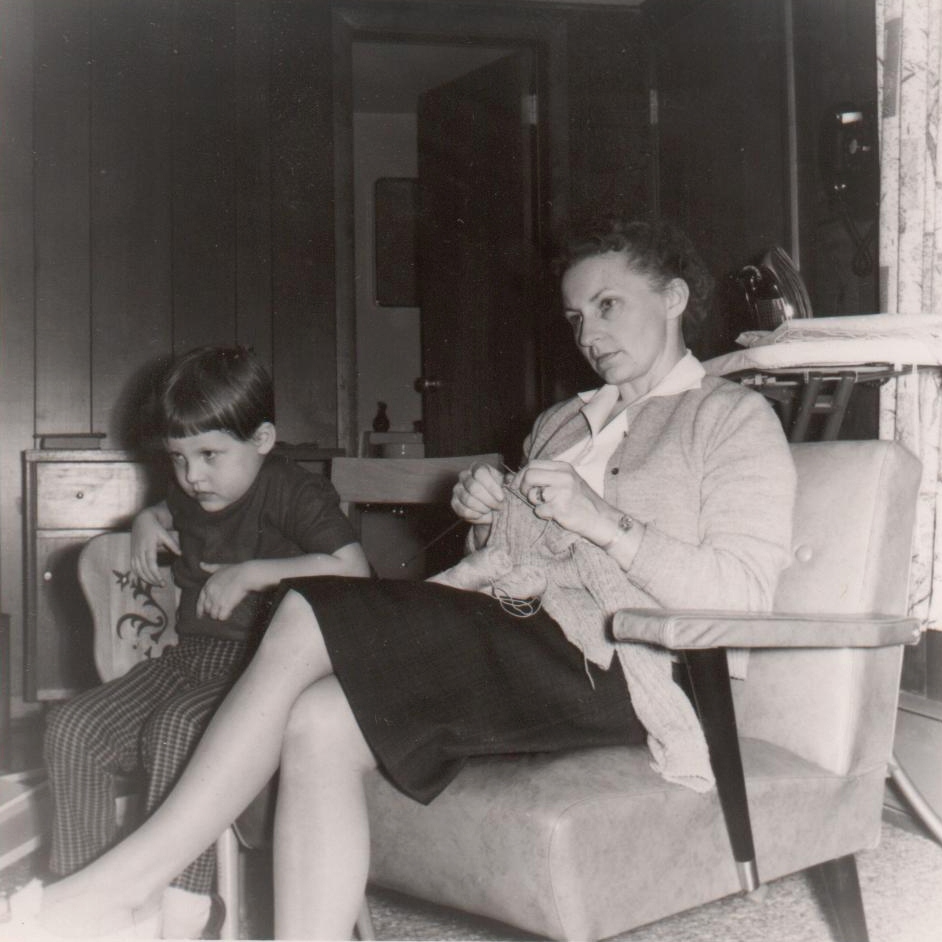
I usually spent evenings in our Rec Room watching TV while my Mom knitted. Mom knitted most of the time. She knitted when she talked on the phone, she knitted when she rode in the car, and she knitted with her friends when they came over for coffee.
I can't imagine what it would have been like to grow up with a Mom who didn't knit.
Suburban Chicago, 1962. I am so anxious to do something, that I nearly jump out of the little painted chair. Mom sits in a naugahyde coral lounger that moved to the basement soon after Dad took this photograph. There's an ironing board behind Mom. My paternal Grandmother, Tatjana, used to iron in the Rec Room while she watched the afternoon broadcast of General Hospital.
Mom must have thought that crochet would be a good "gateway drug" for knitting. That idea didn't float well because I never took to crocheting.
Suburban Chicago, 1962. Mom uses an inexpensive skein to teach me to crochet. Mom has changed into her stay-at-home clothes after a day at the office.
I can't imagine what it would have been like to grow up with a Mom who didn't knit.
Suburban Chicago, 1962. I am so anxious to do something, that I nearly jump out of the little painted chair. Mom sits in a naugahyde coral lounger that moved to the basement soon after Dad took this photograph. There's an ironing board behind Mom. My paternal Grandmother, Tatjana, used to iron in the Rec Room while she watched the afternoon broadcast of General Hospital.
* * * * *
Mom must have thought that crochet would be a good "gateway drug" for knitting. That idea didn't float well because I never took to crocheting.
Suburban Chicago, 1962. Mom uses an inexpensive skein to teach me to crochet. Mom has changed into her stay-at-home clothes after a day at the office.
Remembering Warm Weather
Schweinfurt, Germany, 1945 or 1946. My Dad, on the far left, relaxes in the sunshine with his friends. I can't remember a time when my Dad wore white pants.
UPDATE: My Mom reports that the young woman sitting next to my Dad is the person everyone expected him to marry. Fate intervened when he met my Mom.
Labels:
1945,
1946,
Dad,
Displaced Persons,
fashion,
friendship,
Germany,
Marriage,
Mom,
Schweinfurt
Saving Ourselves
Displaced Persons sought to preserve their national identity. Once the Soviets swooped into the Baltic States, Lithuanians, Latvians, and Estonians took steps to save their cultures.
The DPs published booklets describing Lithuania's history, holiday customs, and family traditions:
Stuttgart, Germany, 1948. "Lithuania, My Dear Country," a short history of Lithuania. The text appears in three languages: English, Lithuanian, and German.
Seligenstadt, Germany, 1948. The cover of "Pro Memoria," a leaflet that chronicles the memories of persons whose families were deported in 1941 to the Gulag camps. The text catalogs the numbers of Lithuanians shipped to the labor prisons. The "inventory" includes the numbers of the train (cattle) cars on which the deportees traveled:
Seligenstadt, Germany, 1947. "Folkdress Costumes for Lithuanian Women," a pamphlet that describes folkdresses, offeres patterns for sewing them, and creates sketches of local versions:
An inside page of the same pamphlet, illustrating the folkdress of a region appropriate for a girl, on the left, and a woman, on the right.
Often the DPs would conduct a "paroda," or exhibit, highlighting some aspect of their culture. Women, for example, sewed miniature Lithuanian folkdresses representing the regional variation. They dressed dolls in the folkdress costumes and put the dolls on display.
Schweinfurt, Germany, 1946. My paternal Grandmother, Tatjana, on the far left, jokes around with two other women as they set up a "paroda" of dolls in folkdress.
Every DP camp also had a wooden shrine with a traditional Lithuanian folk cross. The crosses resembled the ones Lithuanians erect in the countryside and at cemeteries.
Schweinfurt, Germany, about 1948. The traditional cross designates this area as a camp of Lithuanian DPs.
The DPs published booklets describing Lithuania's history, holiday customs, and family traditions:
Stuttgart, Germany, 1948. "Lithuania, My Dear Country," a short history of Lithuania. The text appears in three languages: English, Lithuanian, and German.
* * * * *
Other leaflets preserved more recent history, describing the deportations of Lithuanians to Soviet prison camps:Seligenstadt, Germany, 1948. The cover of "Pro Memoria," a leaflet that chronicles the memories of persons whose families were deported in 1941 to the Gulag camps. The text catalogs the numbers of Lithuanians shipped to the labor prisons. The "inventory" includes the numbers of the train (cattle) cars on which the deportees traveled:
* * * * *
Groups also published pamphlets detailing the history and regional variations of folkdress:
Seligenstadt, Germany, 1947. "Folkdress Costumes for Lithuanian Women," a pamphlet that describes folkdresses, offeres patterns for sewing them, and creates sketches of local versions:
An inside page of the same pamphlet, illustrating the folkdress of a region appropriate for a girl, on the left, and a woman, on the right.
* * * * *
Often the DPs would conduct a "paroda," or exhibit, highlighting some aspect of their culture. Women, for example, sewed miniature Lithuanian folkdresses representing the regional variation. They dressed dolls in the folkdress costumes and put the dolls on display.
Schweinfurt, Germany, 1946. My paternal Grandmother, Tatjana, on the far left, jokes around with two other women as they set up a "paroda" of dolls in folkdress.
* * * * *
Every DP camp also had a wooden shrine with a traditional Lithuanian folk cross. The crosses resembled the ones Lithuanians erect in the countryside and at cemeteries.
Schweinfurt, Germany, about 1948. The traditional cross designates this area as a camp of Lithuanian DPs.
November 18, 2011
Determination
Many Displaced Persons living in the American-occupied zone of post-war Germany finished their educations. My Mom, for example, had started medical school in Lithuania, and she completed her degree at the university at Erlangen.
DPs who graduated from Erlangen were especially proud of their accomplishment because the student body there consisted primarily of Germans. The Erlangen DPs had to keep up with the native speakers. The texts were printed in the German language. Above all, the professors conducted the final exams—oral, final exams—by testing students in groups of four. Often, a DP would land in a group in which the other three students all were Germans.
Erlangen, Germany, about 1946 or 1947. My Mom—standing at the far left in the second row—and fellow medical students gather in anatomy class.
Labels:
1946,
1947,
Displaced Persons,
education,
Erlangen,
Germany,
medical school,
Mom
Stranded
Do you enjoy stranded, or two-color knitting? If your answer is "yes," then here's a link you'll find useful.
Madison, Wisconsin, February 2003. This vest, an item I knitted for Mr. Irene, was the first fair-isle project I designed.
Unleashed
European parents who raised curious, busy children in urban environments saw nothing wrong with using leashes to control their kids.
My Mom occasionally led me on a harness and leash because I was such a turbo child. My family sometimes joked that I had a "motor in the tail."
Mom and Dad even installed a fence in the backyard so that I would not run away.
Once, I took off so fast that I tripped and fell, face first, on our concrete driveway. I skidded several feet. When I stood up, I had a bruised face.
Suburban Chicago, June 1962. The damage to my face doesn't seem to bother me. What am I doing here? Auditioning for an early version of the "Daisy ad?"
My Mom occasionally led me on a harness and leash because I was such a turbo child. My family sometimes joked that I had a "motor in the tail."
Mom and Dad even installed a fence in the backyard so that I would not run away.
Once, I took off so fast that I tripped and fell, face first, on our concrete driveway. I skidded several feet. When I stood up, I had a bruised face.
Renaissance Man
Like his daughter Dora, my Great-Grandfather Silvestras was an intriguing character. Had he been born in my generation, then Silvestras would have been a visionary innovator poised on the edge of technological genius.
We aren't certain how Silvestras—literally—came to win Zigmunta's hand. Despite the peculiar start to their marriage, Silvestras and Zigmunta raised three children together: Edvardas, who died of a ruptured appendix on the cusp of his thirtieth birthday; my maternal Grandmother, Jadzė, who fell to cancer in her early forties, and; Dora, who lived into her mid-nineties, and who died one year after Lithuania regained its independence.
Silvestras first worked in a high school as a music and piano teacher. That profession grew less attractive once Silvestras saw that students don't take music and art teachers seriously. One afternoon—probably in the late 1920s—pupils started pummeling Silvestras with paper airplanes as he sat at his piano bench, his back to the class. That was the last day he taught in a school.
Silvestras then devoted the remainder of his career to piano tuning and repair.
My Mom spent summer vacations in Mariampolis, Lithuania, at the home of her Grandparents. She has textured memories of Silvestras. Silvestras grew his own tobacco. He dried the harvested leaves in the attic. On summer days, Silvestras sat at the dining room table methodically clipping the dried tobacco while he read Jules Verne's Around the World in Eighty Days aloud to my Mom.
Silvestras, like many Lithuanian men, exceled in the folk art of woodcarving. He created toys for my Mom and often crafted walking sticks—another form native art. Silvestras once carved a "špyga," a crude hand gesture, onto the head of a walking stick. Rattling a špyga is equivalent to "giving the finger" in the United States. When someone agitated Silverstras, Silvestras shook the walking stick in the offender's face, thereby avoiding making the impolite gesture himself.
Silvestras carved a violin. He also designed and built a working thermometer and barometer that seems to have been modeled on a cuckoo clock. When the weather was sunny, two wooden children would emerge from the device carrying flower bouquets. When it rained, they stepped out with umbrellas over their heads.
Finally, Silvestras was a master gardener. He grafted branches so that different varieties of fruit would mature on the same tree. Silvestras grew wonderful apples from which he fermented a sweet wine. He even kept a bee hive, and he designed a centrifuge to collect the honey.
Silvestras traveled alone in 1941 to spend Christmas with my Mom's family in Kaunas. Silvestras was in his mid-eighties, and the Nazis had just begun their occupation of Lithuania. Silvestras fell ill and, without antibiotics available to assist him, he acquired pneumonia and died.
Mariampolis, Lithuania, December 24, 1936. My Mom's maternal Grandfather, Silvestras, tunes a piano. The portrait on the top the piano is this one.
Labels:
1936,
1941,
Appendicitis,
cancer,
Dora,
Edvardas,
finger wag,
gestures,
Great-Grandparents,
Jadzė,
Lithuanian language,
Marriage,
Mom,
piano,
Silvestras,
Vacation,
walking stick,
Zigmunta
Guarding the Humans
My Mom and Dad visit friends in Rockford, Illinois:
Rockford, Illinois, Summer 1958. These are the same folks who also had the two black Poodles.
Labels:
1958,
Dad,
Dogs,
friendship,
German Shepherd,
Illinois,
Mom,
Poodles,
Rockford,
Summer
November 17, 2011
Badger Omen
Uh oh. Check out the apron I wore forty-nine years ago:
Suburban Chicago, December, 1962. I wear a "Wisconsin" apron when I bake cookies with Mom.
Labels:
1962,
apron,
baking,
childhood,
Food,
Irene,
kitchen,
modern life,
Mom,
Suburban Chicago,
Winter
Every generation of college kids looks great.
These students resemble models ready for an all-American, tailored fashion shoot.
Hohenheim University, Stuttgart, Germany, 1946. My Dad—the second of two coat-wearing men on the left—stands among friends on a brisk day.
Labels:
1946,
coat,
Dad,
Displaced Persons,
education,
friendship,
Germany,
Hohenheim,
raincoat,
Smoking,
sportswear
Pardon me ...
* * * * *
... but I'm busy.Suburban Chicago, January 1962. I color at my Rec Room play table. The square, ceramic vase is lavender, and it features a bejeweled Poodle. The vase today sits on our guest bath countertop.
We'll be just fine.
Coney Island Boardwalk, New York, 1952. My Mom, on the right, enjoys the company of some fellow Displaced Persons who also recently emigrated to Brooklyn.
November 16, 2011
Scenic Dune Rides!
Sleeping Bear Dunesmobile.
Sleeping Bear Dunes National Lakeshore , Empire, Michigan, July 1961. Mom and I soak up the experience.
Dora and Zigmunta, Later
I introduced my Mom's maternal Aunt, Dora, and my Mom's maternal Grandmother, Zigmunta, in an early post.
After the Soviets occupied Lithuania in 1944, Dora and Zigmunta continued to live in Jadzė's and Jake's house.
Zigmunta and Dora loved little dogs. Dora wrote the dog's name, "Pupsikas" (pronounced "Poop-sick-us") on the back of this photo. "Pupsikas" is a Lithuanian diminutive for "Pupa," a word that means "little bean." It's an affectionate term.
My Mom, for example, has called me "Pupulė" for much of my life.
We've raised two dogs, Pupa and Poppy, who had similar names. I once told a friend that my dog's name means "little bean" in Lithuanian. He responded, "In English, it just means 'shit'."
Kaunas, Lithuanian Soviet Socialist Republic, August 10, 1957. Dora sits with her Mother, Zigmunta, and the Chihuahua / Miniature Pinscher dog, Pupsikas.
Handknit Cardigans
Labels:
1962,
backyard,
childhood,
facial expression,
Irene,
knitting,
Mom,
Suburban Chicago
Camping
My Dad loved to camp as much as he enjoyed being a scout. I never have camped in my life. I have spent multiple nights in overnight "chalets" while hiking in Glacier National Park. Although the chalets don't provide indoor plumbing, they have beds with sheets, so I don't consider that camping.
The area around this campsite today is home to the Lithuanian Museum of Ethnocosmology:
Scout Camp ("Stovykla") at Lake Želva, Lithuania, 1937. Members of my Dad's scouting troop relax by reading and playing chess.
The area around this campsite today is home to the Lithuanian Museum of Ethnocosmology:
Scout Camp ("Stovykla") at Lake Želva, Lithuania, 1937. Members of my Dad's scouting troop relax by reading and playing chess.
Patients Please
My paternal Grandmother once mentioned that she had worked as a nurse. We are not sure when she was a nurse or where she practiced nursing.
This photo tells us she was a nurse in Lithuania: the notes above each patient's bed are written in Lithuanian, not Russian or German.
The clothing—especially the coats—and the hairstyles suggest this photo dates from the latter 1920s.
Lithuania, about 1927. My paternal Grandmother, Tatjana—standing, in uniform, on the far left—poses in a hospital room with patients and their family members.
Labels:
1927,
fashion,
hats,
Lithuania,
Lithuanian language,
nurse,
professions,
Tatjana,
uniforms
November 15, 2011
I love "Ivy."
Madison, Wisconsin, October 2011. Ivy lives with our dear friends. She attended agility classes with our Baci.
Doorway Candid
As I sort old photos, I see that doorway poses are nearly common as shots staged on steps.
This photo catches a candid moment:
Seligenstadt, Germany, Spring 1946. My Mom and her Dad—my maternal Grandfather, Jake—stand at the entry to the Displaced Persons barracks.
This photo catches a candid moment:
Seligenstadt, Germany, Spring 1946. My Mom and her Dad—my maternal Grandfather, Jake—stand at the entry to the Displaced Persons barracks.
Labels:
1946,
Displaced Persons,
doorway,
Germany,
Grandparents,
Jake,
Mom,
photography,
Seligenstadt,
steps
Chemistry
Class.
Kaunas, Lithuania, October 1939. My Dad—seated, second from left—looks through his notes during Chemistry Class.
Labels:
1939,
Aušros Gimnazija,
Dad,
education,
high school,
Kaunas,
Lithuania
Candid Discovery
My Dad was an organizer. He cataloged our photos—old and new—by year and by place. Dad devoted hours to restoring and rephotographing aging snapshots. I often sat with him in his "darkroom"—the master bedroom bath—while he reprinted the old treasures. I consequently have seen most of the photos that I post here; I rarely run across one that is new to me.
I stumbled on a new image yesterday. My Dad had a "to do" box of photos. Some of the photos were ones that relatives had sent to Dad for restoration; others were prints Dad had brought with him from Europe that appear to have been too tiny to restore expertly. Yet others look like ones Dad had planned to rephotograph shortly before he died.
Here is one of those photos. My Dad's twin sister, Jonė, sent this candid to her Mother—my paternal Grandmother, Tatjana—either when Jonė and Tatjana lived in different Displaced Persons camps or after Tatjana already had emigrated to the United States.
Jonė noted on the back of the photo that she found this image unflattering. I don't think so. The photo captures her sweet mannerism and vivid engagement.
Germany, about 1947 or 1948. Jonė walks away from a café with her Ukrainian friend, a fellow Displaced Person.
Labels:
1947,
1948,
childhood,
Dad,
Displaced Persons,
friendship,
Germany,
Immigrants,
Jonė,
master bath,
Master Bedroom,
photography,
Tatjana,
twins
November 14, 2011
A Serious Child
Suburban Chicago, 1964. I sit in our Rec Room, pondering the future. I cannot make out what envelope and paper I am holding.
Do you think I'll blend in if I sit next to the shoes?
One of our hamsters seeks cover near the Lithuanian wooden tchotchkes.
The hamster probably is hiding from me. If I get my hands on a hamster, I'll want it to balance on my head:
Or dance with me, at my Rec Room play table:
Suburban Chicago, 1964. These are snapshots of everyday life in our Rec Room. Tatjana's black sewing machine (the "White" brand) is behind me, and I sit on one of my painted chairs.
Piano Playing
Most members of my Mom's side of the family were expert piano players. Recall Dora, who played as the accompanist at silent movie houses. Her father—my mother's maternal Grandfather—Silvestras had a short-lived career as a high-school piano and music teacher. After he quit that job, he turned to piano repair and tuning. Silvestras evolved into the most sought after piano technician in the city of Mariampolis. He repaired sound boards and carved replacement ivory keys.
My Mom, too, relaxed by practicing a few tunes on the keyboard. Piano lessons at our house were mandatory, and one of the first large pieces my parents bought was that mahogany piano. It looked better than it sounded.
I am sure there were other piano players in the family, too.
I never took to the piano, despite taking lessons for about eleven years.
Kaunas, Lithuanian Soviet Socialist Republic, January 1957. This is Dora. Someone failed to tell her that peacock feathers carry bad luck.
Labels:
1957,
bad luck,
Dora,
Great-Grandparents,
Irene,
Kaunas,
LTSR,
Mariampolis,
Mom,
piano,
recreation,
Silvestras
Subscribe to:
Posts (Atom)