Showing posts with label traditions. Show all posts
October 5, 2016
October 1, 2016
In-the-Woods Reunion
Thatcher Woods, Cook County Forest Preserve, September 24, 2016. Mr. Irene headed back last weekend to the Chicago area for a high-school reunion. He stopped at Thatcher Woods to revisit some memories, and he was happy to find the place in great shape.
July 4, 2016
July 3, 2016
Today's the day.
The Fifteenth Lithuanian Folk Dance Festival takes place today in Baltimore, Maryland. Our Madison-area folk dance group, Žaibas, will perform at the event.
Rosemont Horizon, Rosemont, Illinois, July 1992. Žaibas is ready to march in the dancers' parade.
Labels:
1992,
costumes,
customs,
dancing,
exhibit,
folkdress,
friendship,
hats,
Illinois,
Rosemont,
traditions,
Žaibas
June 24, 2016
Christening
Sacred Heart Church, Melrose Park, Illinois, December 1958. My Godmother's husband must have taken this snapshot; recall Parents and Grandparents do not, in our culture, attend baptisms.
Labels:
1958,
baptism,
childhood,
customs,
fashion,
fur,
Godfather,
Godmother,
hats,
Melrose Park,
religion,
Sacred Heart,
Suburban Chicago,
traditions
June 22, 2016
The Performance
Rosemont Horizon, Rosemont, Illinois, July 1992. The size of the festival's audience catches Mr. Irene's attention.
(Hey! I sewed Mr. Irene's folk costume.)
June 14, 2016
Related by Marriage: Home Wake
Bridgeport, Chicago, Illinois, about 1939. We don't know who died, but Mr. Irene's family saved this image of the entry to a home wake.
June 3, 2016
May 15, 2016
Related by Marriage: Shoot Yourself
Evanston, Illinois, November 1979. A college friend and Mr. Irene try out for Northwestern's annual yearbook tradition, "Shoot Yourself."
May 14, 2016
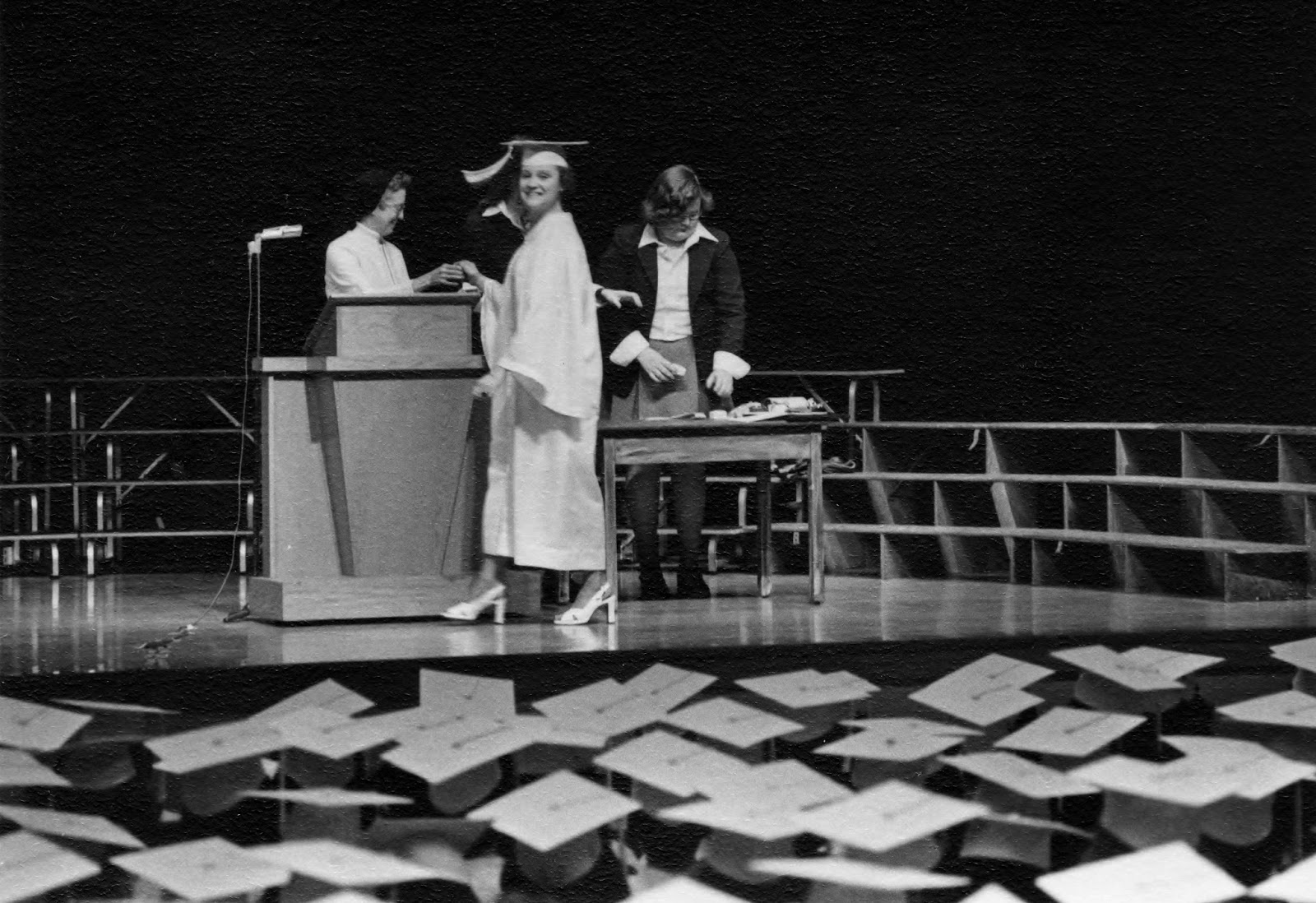
Graduation Weekend, in Three Takes
Labels:
1976,
2016,
Dominicans,
graduation,
high school,
Illinois,
Irene,
nuns,
River Forest,
shoes,
traditions,
Trinity,
uniforms
May 9, 2016
This Year's Banquet
Mr. Irene and I just attended the annual banquet hosted by Madison Vilnius Sister Cities, Inc. Our friends V and her husband again joined us for the weekend. It was a great occasion.
The Madison Club once more decorated the tables in the tricolors of the Lithuanian flag.
This year, Mr. Irene welcomed the guests.
Guests enjoyed cocktails before the meal. Some of us eat the olives first.
We had a great turnout.
The chef is becoming expert at preparing Lithuanian dishes.
We started out with a favorite: Šaltibarščiai.
The kitchen remembered to serve the soup with a traditional accompaniment: boiled potatoes.
Our featured speaker this year was Dr. Audrius Plioplys, creator of the Hope and Spirit exhibit.
The Madison Club once more decorated the tables in the tricolors of the Lithuanian flag.
* * * * *
This year, Mr. Irene welcomed the guests.
* * * * *
Guests enjoyed cocktails before the meal. Some of us eat the olives first.
* * * * *
We had a great turnout.
* * * * *
The chef is becoming expert at preparing Lithuanian dishes.
* * * * *
We started out with a favorite: Šaltibarščiai.
* * * * *
The kitchen remembered to serve the soup with a traditional accompaniment: boiled potatoes.
* * * * *
Our featured speaker this year was Dr. Audrius Plioplys, creator of the Hope and Spirit exhibit.
Labels:
2016,
Audrius V. Plioplys,
beets,
culture,
Deportations,
entertainment,
Food,
friendship,
Irene,
Lithuanian language,
lottery,
Madison,
Mr. Irene,
Napoleonas,
party,
Siberia,
soup,
traditions,
V,
Wisconsin
April 20, 2016
Make one at home.
I started baking in the early 1970s. I don't recall what sparked my interest, but I grew curious about trying new recipes. My paternal Grandmother, Tatjana, did not venture much beyond her own repertoire. My Mom worked full time, so she never cooked, and she only occasionally baked for the holidays. We also had few cookbooks. Besides the 1956 edition of the Betty Crocker Picture Book, I remember the German-language edition of this book, and a copy of European Desserts for American Kitchens.
I started experimenting with some of the recipes in European Desserts for American Kitchens. I first made a Dobos Torte, and then I moved on to a dessert—Crepes Saint Martin—that featured a delicious, rice-pudding-like filling. I finally saw that the book contained a recipe for one of the "triple crowns" of Lithuanian baking: "Baumkuchenas" (the other two "crowns" would be "Napoleonas" and Nut Torte ... at least at our house).
A homemade Baumkuchenas, of course, would not feature the typical "branches" or dough spikes created by baking the cake on a turning rotisserie over an open flame. If you want a Baumkuchenas with the typical appearance, then order one (the mail-order cakes are quite good). The recipe in European Desserts for American Kitchens, however, tastes almost identical to the traditional, branched cake, and I've been making it since 1972. A few years had passed since I made one, so yesterday I got ambitious.
Here's how I adapted the recipe:
1-1/2 cups (7.2 ounces) potato or cornstarch
1 cup plus 2 tablespoons (8.4 ounces) granulated sugar
9 egg whites, room temperature
1/2 teaspoon cream of tartar
1/4 teaspoon table salt
1 cup plus 2 tablespoons unsalted butter, room temperature
9 egg yolks, room temperature
1-1/2 teaspoon grated lemon rind
1 teaspoon pure vanilla extract
3/4 cup powdered sugar
1-1/2 tablespoons freshly-squeeze lemon juice
Adjust the oven rack to about six inches below the broiler element. Preheat the oven—on the broiler setting—to 475 degrees. Line the bottom of a 9-inch springform pan with parchment paper. Grease the parchment paper and the sides of the springform pan with butter. Dust the pan with flour and shake out the excess.
Sift the potato or cornstarch and set aside.
In the large bowl of an electric mixer, with the whisk attachment, begin mixing the egg whites, cream of tartar, and salt and low to medium speed until the egg whites begin to get foamy. Gradually increase the speed to medium-high and then high. While beating, add about 4 tablespoons of the granulated sugar to the egg whites. Continue beating until the meringue is stiff and holds its shape. Set the bowl with the meringue aside.
In another bowl of the electric mixer, with the paddle attachment, cream the butter and the remaining sugar. This should take about 5 to 6 minutes, and the mixture should be very light and pale in color. Add the egg yolks, one at a time, beating well after each addition. Mix in the lemon rind and the vanilla extract.
On low speed (or by hand, using a spatula), mix in about one-third of the potato starch. Gently fold in half the meringue. Then, add one-half of the remaining potato starch and the rest of the meringue. Finally, fold in the remainder of the potato starch.
Before beginning to bake, place the bowl with the batter, a trivet, and a large spoon or ladle near the oven. Using the spoon or ladle (or a small, offset spatula), spread about 1/4 cup of the batter in the bottom of the prepared pan. Place in the preheated oven and bake until the layer is lightly browned. The first layer may take about 2-1/2 to 3 minutes. When the first layer is done, remove the pan from the oven, set it on the trivet, and spread another 1/4 cup batter over the first layer. Continue in this manner until you have used up all of the batter. In our oven, the layers take about 2 to 2-1/2 minutes each, and you should end up with about 14 or 15 layers. The baking process is tedious.
Remove the cake from the oven and let it rest, in the pan, on a wire rack for about one hour. Run a knife around the sides of the pan and remove the springform. Let the cake rest until it is completely cool, about two hours.
Before serving, whisk together the powdered sugar and lemon juice and spread it on top of the cake.
I started experimenting with some of the recipes in European Desserts for American Kitchens. I first made a Dobos Torte, and then I moved on to a dessert—Crepes Saint Martin—that featured a delicious, rice-pudding-like filling. I finally saw that the book contained a recipe for one of the "triple crowns" of Lithuanian baking: "Baumkuchenas" (the other two "crowns" would be "Napoleonas" and Nut Torte ... at least at our house).
A homemade Baumkuchenas, of course, would not feature the typical "branches" or dough spikes created by baking the cake on a turning rotisserie over an open flame. If you want a Baumkuchenas with the typical appearance, then order one (the mail-order cakes are quite good). The recipe in European Desserts for American Kitchens, however, tastes almost identical to the traditional, branched cake, and I've been making it since 1972. A few years had passed since I made one, so yesterday I got ambitious.
* * * * *
Here's how I adapted the recipe:
Baumkuchenas
1-1/2 cups (7.2 ounces) potato or cornstarch
1 cup plus 2 tablespoons (8.4 ounces) granulated sugar
9 egg whites, room temperature
1/2 teaspoon cream of tartar
1/4 teaspoon table salt
1 cup plus 2 tablespoons unsalted butter, room temperature
9 egg yolks, room temperature
1-1/2 teaspoon grated lemon rind
1 teaspoon pure vanilla extract
3/4 cup powdered sugar
1-1/2 tablespoons freshly-squeeze lemon juice
Adjust the oven rack to about six inches below the broiler element. Preheat the oven—on the broiler setting—to 475 degrees. Line the bottom of a 9-inch springform pan with parchment paper. Grease the parchment paper and the sides of the springform pan with butter. Dust the pan with flour and shake out the excess.
Sift the potato or cornstarch and set aside.
In the large bowl of an electric mixer, with the whisk attachment, begin mixing the egg whites, cream of tartar, and salt and low to medium speed until the egg whites begin to get foamy. Gradually increase the speed to medium-high and then high. While beating, add about 4 tablespoons of the granulated sugar to the egg whites. Continue beating until the meringue is stiff and holds its shape. Set the bowl with the meringue aside.
In another bowl of the electric mixer, with the paddle attachment, cream the butter and the remaining sugar. This should take about 5 to 6 minutes, and the mixture should be very light and pale in color. Add the egg yolks, one at a time, beating well after each addition. Mix in the lemon rind and the vanilla extract.
On low speed (or by hand, using a spatula), mix in about one-third of the potato starch. Gently fold in half the meringue. Then, add one-half of the remaining potato starch and the rest of the meringue. Finally, fold in the remainder of the potato starch.
Before beginning to bake, place the bowl with the batter, a trivet, and a large spoon or ladle near the oven. Using the spoon or ladle (or a small, offset spatula), spread about 1/4 cup of the batter in the bottom of the prepared pan. Place in the preheated oven and bake until the layer is lightly browned. The first layer may take about 2-1/2 to 3 minutes. When the first layer is done, remove the pan from the oven, set it on the trivet, and spread another 1/4 cup batter over the first layer. Continue in this manner until you have used up all of the batter. In our oven, the layers take about 2 to 2-1/2 minutes each, and you should end up with about 14 or 15 layers. The baking process is tedious.
Remove the cake from the oven and let it rest, in the pan, on a wire rack for about one hour. Run a knife around the sides of the pan and remove the springform. Let the cake rest until it is completely cool, about two hours.
Before serving, whisk together the powdered sugar and lemon juice and spread it on top of the cake.
Labels:
1970s,
2016,
baking,
cake,
childhood,
culture,
Food,
Irene,
reading,
recipes,
Suburban Chicago,
traditions
March 16, 2016
Dedication
Hanau, Germany, about 1946. My friend Nijole has brought a doll to the scouting ceremony.
Thanks to Nijole for making this photo available to us.
Labels:
1946,
culture,
Displaced Persons,
dolls,
Germany,
Hanau,
Nijole,
scouting,
toys,
traditions,
uniforms
March 10, 2016
Spring Thing
Madison, Wisconsin, Spring 1992. The Madison folk dance group, Žaibas, poses for the shot to be included in the Ninth Lithuanian Folk Dance Festival program.
March 8, 2016
Bridesmaids
St. George's Parish, Bridgeport, Chicago, Illinois, May 1953. Lithuanians commonly used folkdresses as wedding garb.
Thanks to my friend Nijole for making this photo available to us.
Labels:
1953,
bridesmaid,
Bridgeport,
Chicago,
eye glasses,
fashion,
flowers,
folkdress,
friendship,
hats,
Illinois,
Nijole,
traditions,
wedding
March 7, 2016
It's Lithuania Week ...
... all week at the University Club in Madison. We enjoyed our meals there last year, and we'll be there tonight for a Madison Vilnius Sister Cities, Inc. dinner.
Madison, Wisconsin, March 2015. Don't miss the Cepelinai (the star of the show).
* * * * *
Madison, Wisconsin, March 2015. Don't miss the Cepelinai (the star of the show).
March 6, 2016
Backstage Rehearsal
Madison, Wisconsin, November 17, 1991. The women of Žaibas practice Belzdinėlė one more time before we perform at the Madison International Festival.
March 2, 2016
"Irish songs, jokes & Lithuanian Dancers"
* * * * *
* * * * *
* * * * *
February 22, 2016
Final Rehearsal
February 18, 2016
After the Ceremony
St. George's Parish, Bridgeport, Chicago, May 1953. My friend Nijole's Mom (standing, wearing the fur stole) attends a wedding.
Thanks to Nijole for making this photo available to us.
Labels:
1953,
Bridgeport,
Chicago,
fashion,
friendship,
fur,
hats,
Illinois,
Nijole,
shoes,
traditions,
wedding
Subscribe to:
Posts (Atom)