Showing posts with label homework. Show all posts

November 10, 2015

"Bonjour!"


River Forest, Illinois, November 1975. Here's another snapshot from my stint as a high-school yearbook photographer. The woman on the right is the Dominican sister who taught French. I enrolled in French-language classes after I completed my two years of Latin study. She was an amazing teacher: she never allowed us to speak English in her classroom. I felt nearly fluent in French after I completed the coursework.

This teacher's training was so good that when I enrolled in college, I tested out of the foreign-language requirement and earned the equivalent of four years' credit in French. I was so excited when I learned the news that I called her from my dorm room telephone to thank her.

(Does anyone still install terrazzo floors [distinguishable from "terrazzo tiles"]? The Venetian apartment in which I lived had them, too. I just love them.)

September 1, 2015

I return after the first day of classes.


Urbana, Illinois, September 1980. I did my most productive studying in this room. The book on the "sliding bed/couchy thing" is for a course about twentieth-century Russian history. (Russian history was one of my four fields in graduate school.) An engaging professor taught that class. I was sorry to learn he recently died.

April 24, 2015

"She wanted students to see it all."

My beloved high school English teacher, Sister Angele, died last week. Some of the reflections at her wake stirred up memories. 

Although I don't share Sister Angele's love of travel, touring Greece with her was a great experience. She was a tolerant chaperone who left us on a long leash as we explored Greece and Turkey. We dodged serious trouble a couple of times. Our group also avoided some of our responsibilities. For instance, we all carried assignments overseas because we had homework. I was supposed to read Vanity Fair during that trip expressly for Sister Angele's class. I started reading the book on the plane ride home.

When we returned to school, Sister Angele pulled me aside into the hallway outside of her classroom. She warned me not to detail our "escapades" to classmates. Sister Angele's message and tone were stern, but her head posture and glint conveyed an appreciation of the mischief.


Santorini, Greece, April 1976. Sister Angele is the teacher who required us to memorize and recite the prologue to Canterbury Tales in Middle English. She taught me not to fear public speaking, and she introduced me to the study of the Middle Ages. She thereby started two threads that ran through my life.

April 23, 2015

Think Big.


River Forest, Illinois, November 1975. Here's another image from my stint as a high-school yearbook photographer. I took this in the office of the school's library. You likely notice the card catalog and typewriter. Did you see the film-strip canisters?

March 14, 2015

Spring Break


Door County, Wisconsin, March 1982. When I was in graduate school, I spent most "vacations" catching up on my research work. I usually had a pack of 3 by 5-inch notecards in my bag.

November 13, 2014

Keeping her cool.


River Forest, Illinois, November 1975. I served one year as a "photographer" for the high-school yearbook. Here, I captured the amazing nun* who taught our AP English class. She's also the woman who organized and chaperoned that trip to Greece. I credit her with refining my understanding of culture.

*The women who ran the high school were "sisters," not "nuns."

March 11, 2014

"Red pants, that's France!"


Suburban Chicago, November 1960. This clip reminds me of "Red pants, that's France!" I learned that piece of uniform history during my senior year in high school, when I took "Western Civilizations." Western Civ was the course that turned me on to studying history. I liked the class because we used a college-level textbook,* and the teacher, Sr. Francia Shannon, was amazing. She taught us to use primary sources.  

I think my classmate will remember how we repeated, "Le pantalon rouge c'est la France!"

*Our edition was a hardcover with white binding. I saved it for about 30 years; I think I got rid of it when we last moved. I have a newer, paperback, edition on the shelf—one that I used when I taught the course in the late 1980s. I'm annoyed I can't find my high-school volume. It had my underlines and notes. I'm a purger, but this is a time when I regret getting rid of something.

January 20, 2014

Workspace


Evanston, Illinois, April 28, 1978. Here's another view of my desk in the dorm room I occupied during my sophomore year. The framed photo is this one.

September 24, 2013

The Life Box (Part 15)

Here's an extra-credit project I did.* Extra credit. Ridiculous, I think now. I suppose in high school "extra credit" acts as an incentive. Like "do overs" and acknowledgement of  "effort."


*     *     *     *     *

 
*     *     *     *     *
 
*     *     *     *     *
 
 
*     *     *     *     *
 
 
*     *     *     *     *
 
 
*     *     *     *     *
 
 
*     *     *     *     *
 
 
*     *     *     *     *
 
 
*     *     *     *     *
 
 
*     *     *     *     *
 
 
*This is a photocopy of the project. The teacher kept the color original.

September 17, 2013

The Life Box (Part 14)

By the time I enrolled in high school, the parochial curriculum no longer carried a Latin-language requirement. The school offered four languages: Latin, Spanish, French, and Italian. Most Catholic schools offered German instead of Italian; my high school taught Italian because it had a substantial enrollment of first- and second-generation Italian students. I'm sure my Parents would have directed me to study German if that language had been available.

My Parents decided I should study Latin. I wasn't thrilled about Latin because it was not a spoken language. But I came to love Latin for several reasons. First, the Dominican Sister who taught the course—Sister Mary Hope O’Brien—was a delight. She was elderly, and she wore full habit, in the pre-Vatican II style. She had me with that from the outset. Sr. Mary Hope was a tender, thoughtful person. When I had an appendectomy in the winter of my freshman year, for example, she sent some fellow sisters to deliver a care package to me at the hospital (this was back when an appendectomy resulted in a week-long hospital stay). Sr. Mary Hope also taught me the discipline of memorization, drilling, and repetition.

Second, studying Latin led me to appreciate grammar. I only approached grammar with discipline after I had studied sentence structure in the Latin language. My understanding of Latin grammar made it easier for me to study English. It also strengthened my Lithuanian because the Lithuanian language—like Latin—not only conjugates verbs but also declines nouns.

Third, Latin was a foundation on which I built my post-graduate education. I studied medieval history. It would have been difficult to pursue that field without a basis in Latin. Latin, in turn, made the study of French and Italian—also part of the medieval history program—much easier.

Here are some views of my Latin notebook:


*     *     *     *     *


How did a sticker from my Animal Kingdom scrapbook make it into a high-school notebook?

*     *     *     *     *


The drills begin. Here, the drills focus on vocabulary.

*     *     *     *     *


We completed a translation exercise early in the school year.

*     *     *     *     *


Vocabulary and conjugation drills.

*     *     *     *     *


My handwriting doesn't look anything like that any longer.

August 4, 2013

Dorm Room


Evanston, Illinois, October 29, 1977. This is my dorm-room desk. It's not the same room I occupied during freshman year. The Royal typewriter is on the floor.
 
(Visitors to our present-day home will recognize the coffee mug.)

July 25, 2013

Monitored

I wrote earlier about my fear of earning a bad grade. The anxiety blossomed during a 1968 incident. My Parents and my Best Friend's Parents were Nixon supporters during that autumn's campaign. Although Mom had barred me from engaging in activities in which I mixed with the public—no lemonade stands, solicitations, or the like—my Best Friend and I hatched a plan. In the late afternoons, after school, we stood on a busy intersection corner near our homes and waved "Nixon's the One" signs at the passing commuters. Many drivers honked; their attention encouraged us to continue campaigning.

My Best Friend and I decided we needed professional-Nixon gear. My Best Friend's older sister—who at that time may only have had a learner's permit—drove us to the Nixon campaign office on Fifth Avenue, in Maywood, Illinois. The workers there gave us straw hats, signs, and paper bags—lunch sacks—filled with "Nixon's the One" buttons. We continued our corner patrol. As cars approached the stop sign, we handed out fistfuls of the buttons.

I had great fun during the campaign season, but the political distraction ate into my study time. In late October, I took an essay exam in my fifth-grade American History class. I wrote my name, date, and home room number neatly on the first three lines of the loose-leaf page. In the upper right corner, in tiny letters, I wrote "Nixon's the One." I added three exclamation points after the phrase, and I underscored the word, "One." I don't remember the specific question the teacher had posed, but the exam tested our knowledge of the Monroe Doctrine.
 
I got a "D" on the exam. The Rec Room rumbled when I showed the score to my Mom. Mom implemented a regimen of supervised studying. Initially, she required me to sit next to her on the sofa, where she listened for an hour or so as I read my American History lessons aloud, nightly. The oversight eased over time—Mom gradually allowed me to read silently—but for many years, she watched me as I studied next to her in the Rec Room, ensuring that I didn't lose my focus.


Suburban Chicago, April 1970. Mom looks annoyed here, but she's probably just focused on her knitting. She's also reading; Mom often "multi-tasked."

*     *     *     *     *


Suburban Chicago, May 1978. I prepare for a final exam in a History and Literature of Religions course. My leg is in a cast because I fell out of window on campus. It was a foolish incident; I'll write a post about it later. Mom is on call because the phone is within reach.

June 18, 2013

The Life Box (Part 6)


Suburban Chicago, 1968. I do the "what-I-did-on-my-summer-vacation" assignment in pictorial form. Daddy saw an otter, and I saw 10,000 chipmunks.

June 11, 2013

The Life Box (Part 5)

In the 1970s, my high school—like many others of that era—divided students into groups based on the school's perceptions of our potential. Students clustered in the "AP" category enrolled in college-prep courses with demanding workloads. I often found the homework expectations overwhelming. There were many nights when my Parents permitted me to stay up beyond my bedtime so that I could finish assignments.

Most homework projects were rewarding. I enjoyed doing the newspaper project that accompanied our study of Romeo and Juliet. The same teacher who assigned the newspaper project also required us to write a play. I wrote a story about a man fleeing life behind the Iron Curtain. 
 
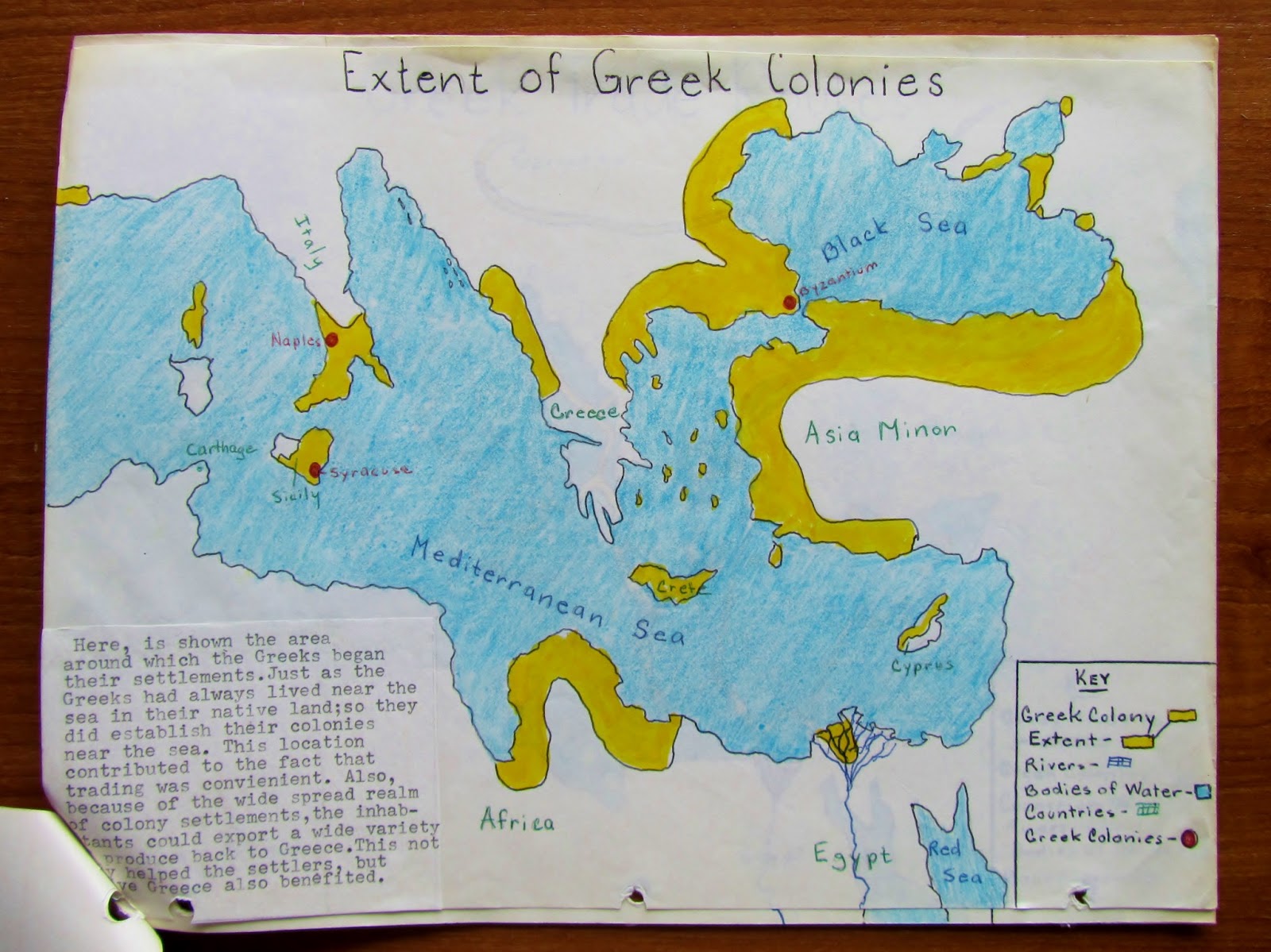
During my freshman year, I took a "World Civilizations" course. It was one of my favorite classes. Early in the year, the teacher assigned a "team project." We were to work in groups of two or three girls, and we were to produce a document that illustrated our understanding of ancient Greece. I chose to work with a classmate that I had met in gym class during the first week of school. 
 
Here are some snapshots of the assignment we submitted forty-one years ago. A few thoughts popped into my head as I looked at the project today: (1) In my first career, as an historian, I focused my research on Mediterranean piracy (see the last paragraph of the project's text); (2) The teacher who created this assignment still teaches at my high school; and (3) My partner on the project and I keep in touch, and she occasionally visits the blog.


*     *     *     *     *


*     *     *     *     *


*     *     *     *     *


*     *     *     *     *


*     *     *     *     *


*     *     *     *     *


*     *     *     *     *


May 11, 2013

The Verona Morning Star


My favorite high-school teacher also taught English. We students thought this teacher was cool because she was only eight years older than we were. She was fresh out of college. She was stylish: her clothes were a bit hippie Bohemian, and she styled her hair in a long shag. The teacher spoke to us as if we were adults, and she often peppered her vocabulary with words we hadn't hear before. She moderated the "Creative Writing Club," which I joined, and she took a group to hear Germaine Greer speak at the local community college. (What I remember most about Greer's lecture was how Greer flirtatiously played with her long, silk scarf throughout the talk).
 
During my sophomore year, the teacher assigned Romeo and Juliet. To test our understanding of the play, she assigned an unusual homework project. We were directed to create a newspaper that knit the themes of the play and showed our grasp of its historical setting.
 
We received the assignment on a Friday, and it was due the following Monday. When I returned home from school, I headed that afternoon to my Best Friend's house. My Best Friend was artistic, and I hoped she'd have some materials with which I could craft the piece. We found some large sheets of newspaper stock in her supplies. My Best Friend and I went out to her backyard, where we burned the edges of the paper to make it appear aged. From there, I spent the weekend writing up stories about Renaissance Verona on my Parents' Royal Typewriter. I drew advertisements, maps, and a comic strip. 
 
The assignment was the most memorable one I completed. What I learned from this teacher—and from my other, favorite teachers—was that good teachers don't teach you material; they teach you to think differently and apply what you've learned critically.
 
 
Suburban Chicago, October 12, 1973. A piece of twine originally held the two pages of my newspaper together.
 
*     *     *     *     *
 
 
Page 2 featured a column by Margarita's Mouth, "Verona's Galloping Gossip."

May 10, 2013

It's the last day of school.

Exam season is here again.


Door County, Wisconsin, November 1984. When I returned from Venice, I no longer worried about exams, but I spent the next year organizing my research—recorded on 3 by 5-inch note cards. Many nostalgic items (besides the ashtray and cigarettes) appear in this photo: a bottle of "Liquid Paper," an airmail envelope, the inkwell for my Parker fountain pen, a copy of Essential Italian Grammar, a Latin dictionary, and the corduroy pencil case I bought in Venice.

February 17, 2013

Sunday Butterflies


Suburban Chicago, December 1971. Gigi helps me finish my homework before I go back to school on a Monday. I'm working at my Dad's desk in the Master Bedroom.

I don't recall whether I was studying there because Dad was helping me with my homework, or whether he and Mom just were making sure I did it.

November 17, 2012

Take a study break.


Urbana, Illinois, June 1981. I'm settled in my first "solo" apartment. It's the end of the semester, and I am working on a paper. The electric typewriter is in use, and a box of notecards rests next to it.