It's time for the kindergarten class to stage the Christmas play.
I'm easy to spot because I am the only kid who's wearing eye glasses.
Suburban Chicago, December 1963. The teacher chose the prettiest girl to play the Blessed Virgin. She prays over the manger while I daydream, dressed in a dark jumper.
Suburban Chicago, December 1963. We sing for the visiting parents. I am just left of the tree, disengaged, looking out the window. I was a little misfit.
Suburban Chicago, December 1963. We dance around the room. I am just to the left of the teacher.
These were bumpy times for me, because I still spoke little English.
Suburban Chicago, December 1963. Finally! The teacher gives each child a gift.
December 9, 2011
Picnic Culture: An Informal Display
Here's one of my favorites:
End of the Work Week
The end of the week is almost here. Aren't you glad you won't have to drive to work tomorrow?
Suburban Chicago, October, 1961. Mom pulls out of the driveway on her way to the office. She's behind the wheel of "The Swan," her beloved Buick Invicta. See? Its interior was red.
Labels:
"The Swan",
1961,
fashion,
medicine,
modern life,
Mom,
physician,
Suburban Chicago,
work
December 8, 2011
Do you think we'll blend in if we wear stripes?
Glacier National Park, Montana, July 1970. Mom and I take a rest after we reach Sperry Glacier. I remember her top; it was white with beige and black stripes. That top logged many miles.
Labels:
1970,
blending in,
childhood,
Dad,
eye glasses,
fashion,
Glacier National Park,
Gunsight Pass,
hiking,
Mom,
Montana,
Parents,
photography,
recreation,
Sperry Glacier,
striped top,
Vacation
This is the home that she remembers.
My maternal Grandparents, Jake and Jadzė, built this house in Kaunas, Lithuania. This was my Mom's childhood home.
During the Soviet invasion, the Russians passed laws restricting how many square meters one person could occupy in a living space: "to each according to his needs." The government repossessed anything over that alloted fair share and doled it out to other people—strangers ("square-meter redistribution"). The Soviets decided that this house was too bourgeois for one family. So they moved multiple groups of Russian soldiers into the first floor rooms, and they allowed my Mom, Jadzė, and Jake to dwell in part of the second floor.
After the war, my Mom's maternal aunt, Dora, lived in an apartment in the house.
Kaunas, Lithuania, December 1935. The house was a European-style log home.
Labels:
1935,
Dora,
Hipodromo gatvė,
Jadzė,
Jake,
Kaunas,
Lithuania,
LTSR,
Mom,
Soviet Union,
World War II
Related by Marriage: You're in the Army!
Mr. Irene's Dad—"Father-in-Law"—was younger than my Parents. When he sailed to the United States in June, 1949, he still was an unmarried man. Father-in-Law, like all Displaced Persons who arrived in America, had the "sponsorship" of a U.S. citizen. A sponsor ensured that the new arrival would have housing, would not displace any American workers, and generally would stay out of trouble. Father-in-Law's sponsor was a distant relative whose family had settled in Chicago as part of the first wave of Lithuanian immigrants.
Father-in-Law initially settled in Brighton Park, a south-side, Lithuanian enclave similar to Marquette Park. Because he lived in Brighton Park, Father-in-Law had few opportunities to speak English. He carried out his work life and his social life in the Lithuanian language.
Father-in-Law got an unexpected notice about twenty months after he emigrated to the States. The U.S. Army had drafted him. The Korean War was under way, and the U.S. Army stationed Father-in-Law at the base in Barstow, California as … a tank instructor. This life change meant that Father-in-Law learned English rather quickly. He hung around with a bunch of privates, and his closest buddy was a cook in the mess hall. Father-in-Law learned Army-base English.
Father-in-law was eager to show his sponsor's family how proficiently he had absorbed the nuances of the English language. On leave for Thanksgiving, he headed home to Brighton Park. Sitting at the holiday table, and midway through the meal, Father-in-Law asked, "Would someone please pass the fucking potatoes?"
The stint in the U.S. Army had additional benefits. First, the timeline for Father-in-Law's naturalization process sped up because of his service in the military. Second, as a Korean War vet, Father-in-Law qualified to join the V.F.W. It was at a V.F.W.-sponsored event that Father-in-Law first met Mr. Irene's Mom.
Camp Irwin, Barstow, California, February 16, 1951. Father-in-Law looks happy.
Labels:
1949,
1951,
Barstow,
Brighton Park,
California,
Camp Irwin,
Displaced Persons,
Displaced Persons Act of 1948,
Father-in-law,
Mother-in-law,
Mr. Irene,
Related by Marriage,
U.S. Army,
uniforms,
V.F.W.
A Man and His Dog
Kaunas, Lithuania, November 1940. When I saw this photo in Mom's album, I asked, "Who's the guy with the cute dog?" She replied, "That's one of Dora's friends."
December 7, 2011
Stay Put
Suburban Chicago, May 1959. Mom ties my shoe. She's also likely hanging on to me so that I don't run off. We sat for this photo before my Parents erected a fence in the backyard.
Labels:
1959,
backyard,
childhood,
fashion,
fence,
Irene,
Mom,
striped top,
Suburban Chicago
Down By the River
Cherry Picking
My Parents began vacationing in Door Country, Wisconsin, in the mid-1970s, shortly after my paternal Grandmother, Tatjana, had died.
(The Door peninsula is the "thumb" of the Wisconsin mitten, in case you're tracking that debate.)
By then, my Dad's health wasn't great, so he and Mom decided it wouldn't be wise to continue making the three-day drive from Chicago to Glacier National Park. He'd fallen ill once while visiting Glacier, and it wasn't a good experience. At the time, the closest hospital that could admit him was a somewhat primitive facility forty miles away, in rural Canada.
Mom and Dad bought a property on Door County's "Quiet Side," in the Town of Liberty Grove. They traveled to the place once a month for a long weekend, and in the summers, they vacationed there for about four weeks. My Dad found the getaway exquisite. He did things there that he no longer did in the city: he chopped firewood, mowed grass, carved walking sticks, and cross-country skied.
My Parents bought the property from an old-time farming couple who traced their roots on the peninsula back several generations. The farmers kept on eye on the property when my parents were away, and they graciously offered us farm-fresh eggs when we visited. They also let us pick cherries in their orchard. There was little more satisfying than tying on that pail and spending the afternoon in the breeze, with a dog, plucking sour cherries from the dainty trees.
Door County, Wisconsin, August 1978. My Dad picks cherries while our Poodle, Gigi, watches. The farmers' Collie dog has joined Dad and Gigi in the orchard.
Labels:
1978,
animals,
cherries,
Collies,
cross-country skiing,
Dad,
Dogs,
Door County,
Gigi,
Glacier National Park,
mittens,
Mom,
Montana,
Parents,
picking,
Poodles,
Tatjana,
Vacation,
walking stick,
Wisconsin
Alpha Baba
My paternal Grandmother, Tatjana, was no wallflower. Although our "Baba" usually was cuddly and soft—inside and out—sometimes she revealed her canyons of hardship.
Tatjana occasionally articulated her resolve by wagging her finger. This could be bad or good. For example, she often delivered the gesture as a threat—"Wait till your Mother gets home" or "I'll leave if I don't get my way." At other times, she used it as an affectionate softener when she offered sage, but unsolicited, advice—"I told you so."
I couldn't distinguish between the two finger-wagging genres when I was a kid: the wagging finger always sent me flying.
This photo likely illustrates the good, "See, I'm older and smarter than you," kind of delivery:
Suburban Chicago, December 1970. Fire in those melancoly eyes: Tatjana drives home a point while talking to my Godfather.
Labels:
1970,
childhood,
finger wag,
gestures,
Godfather,
Illinois,
Irene,
jabot,
melancholy eyes,
Mom,
Mr. John,
Suburban Chicago,
Tatjana
December 6, 2011
Show Dog Reunion
Monona, Wisconsin, August 2005. Rex auditions for the show-dog circuit. Two factors eclipsed that career: (1) we did not want an intact dog in the house; and (2) he was unruly ... on a leash.
Leashed
I didn't know, until today, that we have a photo illustrating the sensibility of leashing a turbo child.
Brooklyn, New York, March 1948. My Dad's twin sister, Jonė, uses two hands to control a relative's toddler during an Easter afternoon walk. Her paternal aunt, Victoria, enjoys the moment.
Playing with Shadows
I first noticed how shadows factor into some family snapshots when I scanned this image of my paternal Grandfather, Vytautas.
Shadows arise noticeably in photos in which my Dad was the subject and in photos he took.
Here is an early example of what I mean:
Kaunas, Lithuania, about 1933. I am guessing at the year here, based on my Dad's age.
* * * * *
Here is a later example; Dad used the self-timer for this shot:
Suburban Chicago, October 1961. Dad sits on the green, "mid-century modern" sofa. One of the things I notice about photos from the 1950s and 1960s is the height at which people hung paintings.
Christmas on Display
A few evenings ago, Mr. Irene and I rode through our neighborhood. We noticed that our home was one of the few that had no outdoor Christmas decorations on display.
"People will think we're heathens," I said.
Mr. Irene replied, "It's what's inside that matters."
Suburban Chicago, December 1961. Here's the view from the driveway of my childhood home at about this same time of year.
"People will think we're heathens," I said.
Mr. Irene replied, "It's what's inside that matters."
Suburban Chicago, December 1961. Here's the view from the driveway of my childhood home at about this same time of year.
Labels:
2011,
childhood,
Christmas,
Dad,
holidays,
Irene,
Mr. Irene,
photography,
Suburban Chicago,
Verona,
Wisconsin
Echoes of DP Culture
My Parents moved away from Brooklyn, New York in the mid-1950s. Mom secured an Illinois medical license and a job in Chicago, so the family resettled in the Midwest. Many Displaced Persons who landed in Chicago made homes in Marquette Park, a community in the heart of the south side that historically was home to many Lithuanians.
My Dad vetoed setting up a household in Marquette Park. He announced that he'd lived in a DP camp long enough, and he did not want to duplicate that experience.
My Parents instead chose to live in a small suburb about nine miles outside of the loop. There was a nest of Lithuanian families in that suburb. Despite their presence, those of us who grew up outside of Marquette Park never were immersed fully in the motherland's culture. It's true that I didn't speak English until I started Kindergarten. But many of the Marquette Park kids continued to speak English with a Lithuanian accent into adulthood. Although the Marquette Parkers could go around the corner and get a plate of Kugelis whenever they had a craving for it, I don't think many of them met a non-Lithuanian—or a non-Catholic—until they started college. Many of those first-generation children seemed themselves displaced, not quite assimilated into American culture.
We sometimes visited the "Lithuanian core." Dad occasionally exhibited photos at the Lithuanian Youth Center, and, during the holidays, we shopped at the Lithuanian delis that carried the foods served at Kūčios. We never, however, were knitted into the social fabric of Marquette Park.
The suburbanites ensured that their children connected with their Lithuanian culture. We attended Lithuanian Saturday school. There, we learned to read, write, recite poetry, and folk dance. In the autumn, our Lithuanians hosted a formal dinner dance. In the summer, they organized picnics at which we ate Lithuanian food and played Lithuanian games.
Finally, the Lithuanian families in our suburb took turns hosting the annual New Year's Eve party and Christmas Day dinners.
Suburban Chicago, December 25, 1961. The suburban Lithuanians gather at my Parent's home for a Christmas Day celebration. My paternal Grandmother Tatjana, sitting at the front, on the left, seems quite satisfied with the affair. My Mom, standing on the right, probably is checking to see if anyone needs anything. Of the persons visible in this photo, my Mom now is the only survivor.
* * * * *
The suburban Lithuanians did a good job. I married Mr. Irene—who grew up in the same suburb—and we still speak Lithuanian at home.
Labels:
1961,
assimilation,
Christmas,
Dad,
dancing,
Displaced Persons,
entertaining,
Kūčios,
Lithuanian language,
Lithuanian school,
Marquette Park,
Marquette Parkers,
Mom,
New Year's,
picnics,
Suburban Chicago,
Tatjana
December 5, 2011
Amling's Flowerland
Amling's Flowerland, an historical establishment on North Avenue in Melrose Park, Illinois, used to be a key holiday shopping stop. A newer housing development popped up near Amling's in the late 1950s. The Amling's property took up several acres in Melrose Park's commercial zone.
(Melrose Park's motto was "Corporate King of the Suburbs.")
Amling's, like Kiddieland, played a part in building my early memory bank. I think it had a role in other people's recollections, too. Today, for example, when I searched for additional historical information about Amling's, I encountered an interesting detail. Many families mentioned in a decedent's obituary that the loved one had worked at Amling's.
When prom season arrived, the cool teenagers visited Amling's to buy expensive corsages and boutonnières. I remember following a relative to the back of the store, where the artists arranged the corsages. The smell of the ripe orchids, mixed with the humid, florist's air, made me queasy.
During the summer months, parents took children to the Amling's pond, which had a small raft of ducks. We fed Wonder Bread to the fat, white ducks. They were friendly ducks, and they never snapped at us.
In October, we visited the elaborate—and awesomely scary—Amling's Haunted House. After the fear of the haunted visit had caused us to "crawl out of our pelts," as Lithuanians say, we stepped outside and rode the Ferris Wheel on the Amling's property.
At Christmas time, Amling's sold "flocked" natural Christmas trees. One rarely sees flocked, real trees any longer.
The most fascinating Christmas tradition that Amling's maintained was its life-size Bethlehem village. The display consisted of (a 1960s understanding of) a Bethlehem replica, complete with statutes of all the players in the Christmas story. To a toddler, it was an impressive site.
"Amling's for … 'Every Bloomin' Thing'."
Melrose Park, Illinois, December 1960. Amling's erected the Christmas stable near its pond.
Melrose Park, Illinois, December 1960. The display featured life-size statutes of the Wise Men.
Melrose Park, Illinois, December 1960. A camel followed the Wise Men to the stable.
Labels:
1960,
Amling's,
camel,
childhood,
Christmas,
ducks,
flowers,
Halloween,
holidays,
Illinois,
Irene,
Kiddieland,
Lithuanian language,
Melrose Park,
modern life,
Nativity,
shopping,
Suburban Chicago,
Winston Park
Here, she speaks to me.
This photo of my maternal Grandmother, Jadzė, was taken at about the same time as the serene portrait in which her smiling face reminded me of Mona Lisa.
Mariampolis, Lithuania, 1920. Jadzė reveals a different side.
Related by Marriage: Assimilating and Eligible
Imagine the mechanics that were necessary to maintain a waist so cinched. The elaborate Gibson-Girl coiffures appear equally complicated.
Bridgeport, Chicago, Illinois, 1914. Mr. Irene's maternal Grandmother, Anna—on the right—stands with her cousin. This photo was taken about four years after Anna emigrated to the United States and three years before she married.
Do you go to Grandma's house for Christmas?
My Mom used to travel from Kaunas to Mariampolis to spend Christmas with her maternal Grandparents, Silvestras and Zigmunta.
Mom remembers the vividly colored, German-made, glass ornaments that hung on the tree.
Mariampolis, Lithuania, December 25, 1936. My Mom's maternal Grandfather, Silvestras, sits at his piano while his wife, Zigmunta, looks like she has something on her mind.
UPDATE: Recall that my Mom celebrated Easter with her paternal Grandparents.
December 4, 2011
Related by Marriage: Holy Communion (Part 3)
We have no trouble dating this photo:
Bridgeport, Chicago, Illinois, 1928. Mr. Irene's maternal Aunt, Aunt M, celebrated her First Holy Communion at the Lithuanian parish, St. George's Roman Catholic Church.
Related by Marriage: Picnic Culture
Lithuanian churches, like the Roman Catholic Parish of St. George, organized picnics at Vytautas Grove, on Chicago's South Side.
These were key occasions for "first wave" Lithuanian-Americans, who saw the elaborate picnics as a chance to escape their working-class routine.
Picnics, like most other Lithuanian entertaining, usually occurred on Sundays. By the early 1950s, the picnics became meeting grounds at which the offspring of "first wavers" could meet newly arrived—and eligible—Displaced Persons.
Vytautas Grove, Chicago, Illinois, Summer 1949. Mr. Irene's maternal Grandparents slip into their finery for a Sunday picnic. Mr. Irene's Grandfather, Stanley, has his mouth full, and Mr. Irene's Grandmother, Anna, wears a hat and a butterfly-print dress.
Congratulations, UW Badgers
Rose Bowl bound, two years in a row.
Madison, Wisconsin, October 15, 2011. Coach Bret Bielema and members of the UW Football team watch a replay on the big screen.
Sunday Promenade: Coat Edition
I asked my Mom whether Jake's friend, the tailor, had sewn this striped coat for her.
He did not. Mom got the coat from UNRRA, which distributed the hand-me-down to Mom as part of its relief efforts. Mom made the most of it:
Erlangen, Germany, 1946 or 1947. My Mom models a "new" coat. She stands between two medical-school classmates. Check out the platform shoes worn by the woman on the far left.
December 3, 2011
Keep the stroller handy.
And make sure Raphael's adorable angels watch over you:
Kaunas, Lithuania, about 1932 or 1933. Mom sits on the edge of her bed with a favorite doll. The screen, featuring swans, seems to be a different one than the screen that appeared here.
Picnic Culture: Fishing Opportunity
Picnics along the Fox River gave me the chance to go fishing.
Geneva area, Illinois, June 1962. I fish, wearing a "play dress."
Picnic Culture: Introduction
Lithuanians who settled in the United States often socialized at picnics. Most organizations hosted annual picnics that were elaborate affairs. The Lithuanian daily newspaper, for example, hosted a picnic to which people drove from around the city of Chicago.
In our community, the families that sponsored a Lithuanian-Saturday school organized a picnic early every summer along the shores of the Fox River, in Illinois, near Geneva.
Everyone got dressed up and brought a dish to pass. The children ate a separate table, of course.
Geneva area, Illinois, June 1961. The adults organize the youngsters around the children's table. My Mom is on the far left.
Geneva area, Illinois, June 1961. My Mom, right, and a friend relax after the meal.
Geneva area, Illinois, June 1961. My paternal Grandmother, Tatjana, second from left, watches me as I sit on an admirer's lap.
Geneva area, Illinois, June 1961. My paternal Grandmother, Tatjana, talks to a family friend, who holds her Chihuahua, "Murzė." I was afraid of that dog.
Labels:
1961,
Chihuahua,
childhood,
Dogs,
fashion,
Geneva,
Illinois,
Irene,
Lithuanian school,
modern life,
Mom,
Picnic Culture,
picnics,
Tatjana
Class Picture
I wrote earlier about how Lithuanians used high-school uniforms as a way to identify students when those students were not in the classroom.
This photograph of my Mom and her classmates reminded me of different point. Look at the first row of students. The young women all are wearing black flats that resemble ballet shoes. Why? The (relatively newly built) high school featured highly polished, herringbone parquet floors. The school administration required students to change into soft-soled, heel-free shoes once they were in the building. This prevented damage to the wood floors and reduced noise during the school day.
Kaunas, Lithuania, about 1940. My Mom—second row, second from left—laughs during a sitting for a class picture. Five male teachers are on the top row.
December 2, 2011
If you play in the sun, then cover up.
Cape Cod, Massachusetts, July 1963. Mom wraps me up so that I don't get sunburned. This was the "Coppertone" era. But Mom knew that sun exposure caused damage, even before most people acknowledged its aging effects.
Coiffures
Erlangen, Germany, 1947. My Mom smiles for the camera while two of her medical-school classmates—fellow DPs—contemplate the moment.
Related by Marriage: The Wedding Day
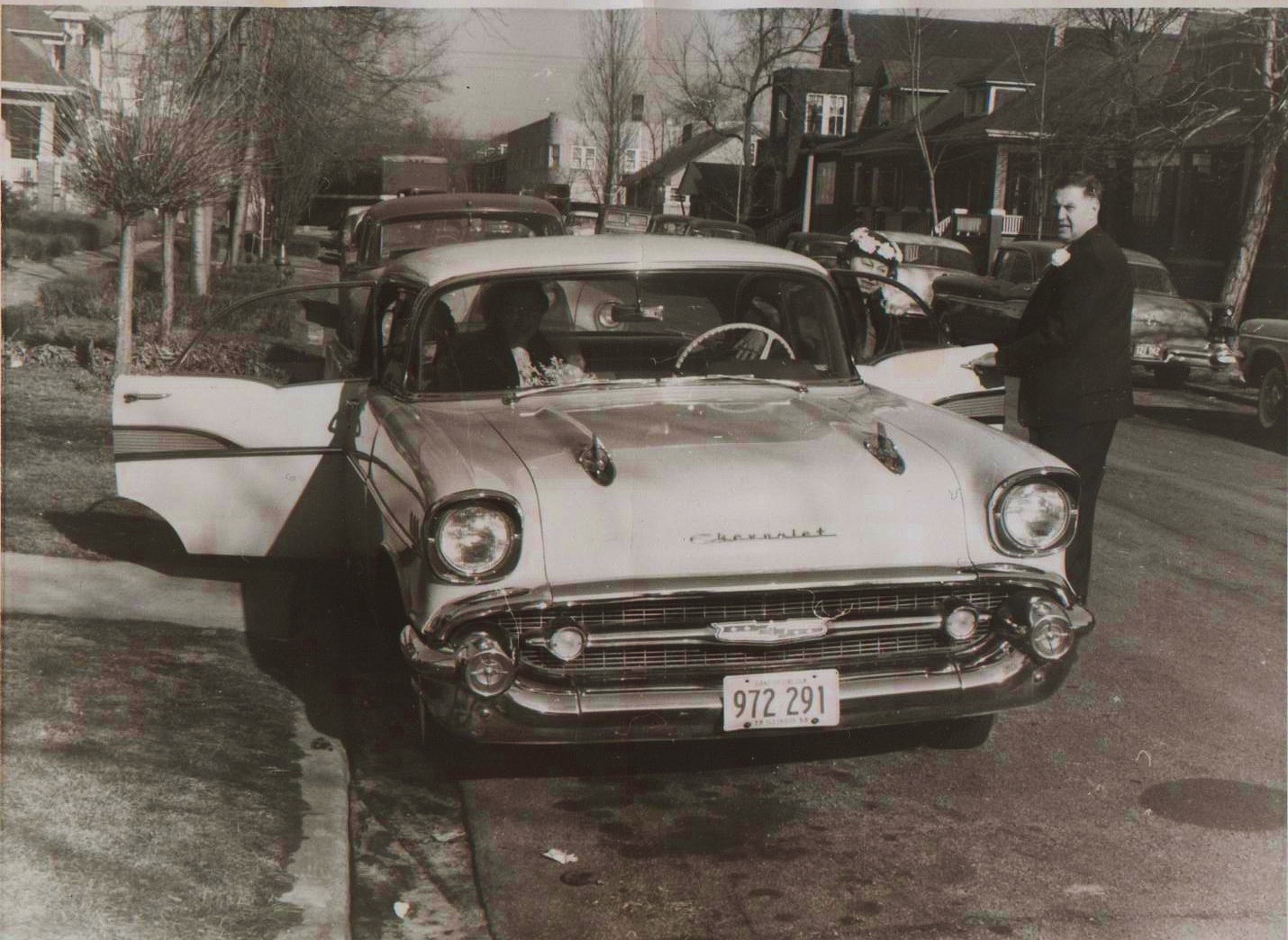
Here's Mr. Irene's Mom, in the front seat of a 1957 Chevy, on her way to the Church to get married.
Marquette Park, Chicago, Illinois, January 1958. Mr. Irene's maternal Grandfather, Stanley, holds the back-seat door for his wife, Mr. Irene's maternal Grandmother, Anna.
Labels:
1957,
1958,
Anna,
cars,
Chevy,
Chicago,
hats,
Illinois,
Marquette Park,
Marriage,
modern life,
Mother-in-law,
Mr. Irene,
Related by Marriage,
Stanley,
wedding
I don't like riding in the back seat.
Here I am, in the backseat of "The Swan," feeling green during our road trip from Chicago to Toronto and Wasaga Beach, Ontario.
Looking at this photo now, I recall the distinctive smell of the red vinyl interior.
Ontario, Canada, July 1960. My paternal Grandmother, Tatjana, keeps me company in the back seat. I am propped on my favorite childhood pillow, an object that I carried on every vacation.
Looking at this photo now, I recall the distinctive smell of the red vinyl interior.
Ontario, Canada, July 1960. My paternal Grandmother, Tatjana, keeps me company in the back seat. I am propped on my favorite childhood pillow, an object that I carried on every vacation.
Labels:
"The Swan",
1960,
cars,
childhood,
Irene,
Mom,
Ontario,
Summer,
Tatjana,
Toronto,
Vacation,
Wasaga Beach
Scout
Kaunas, Lithuania, about 1932. Dad wears his scouting uniform. He must have been proud of the uniform because at around this time; he wore it—or part of it—to dinner.
December 1, 2011
Iceberg Lake
Glacier National Park, Montana, July 1966. Mom and I have reached Iceberg Lake, the endpoint of our five-mile hike. There's not a bear in sight.
Labels:
1966,
bears,
childhood,
Dad,
eye glasses,
Glacier National Park,
hiking,
Irene,
Mom,
Montana,
photography,
Summer,
Vacation,
walking stick
Hang on to your hats.
When I linked today to the first post of this blog, I remembered that we have another photo from the Atlantic crossing.
Now you see that babushka wearing goes way back in our family.
Atlantic Ocean, June 1949. My Mom, in the center, stands on the deck of the "General Black" as she and fellow Displaced Persons sail to New York City.
Now you see that babushka wearing goes way back in our family.
Atlantic Ocean, June 1949. My Mom, in the center, stands on the deck of the "General Black" as she and fellow Displaced Persons sail to New York City.
Labels:
1949,
Atlantic Ocean,
Displaced Persons,
Family,
Germany,
Happy,
hats,
Immigrants,
Marriage,
Mom,
Parents,
Travel
The Cohort of 1951
When my Parents arrived in Brooklyn, New York in 1949, neither one of them spoke English. They consequently had trouble finding work. Relatives who had emigrated to the United States earlier than my Parents urged Mom to scan the want ads in the Journal of the American Medical Association. Problem: she couldn't read English, and she didn't know how to fill out a job application.
There were no English-language classes for immigrants. Mom and Dad learned to read English by borrowing library books. They started with children's literature. My Mom felt that her English was proficient when she fluidly digested the works of Charles Dickens and Jane Austen.
Mom landed her first job at Wyckoff Heights Hospital. The hiring staff there didn't believe that she was a physician, so they initially placed Mom in the lab, where she worked as a technician. When her medical-school paperwork arrived from Germany, the staff acknowledged her diploma and started calling her "Dr." instead of "Mrs."
There were only three women in Mom's internship cohort. All three women were recent immigrants.
Brooklyn, New York, 1951. My Mom—the woman on the far left—sits among the other interns.
Ladies, please fold your hands.
Meškė
Our first dog, Gigi, lived just over nineteen years. She was especially close to my Dad.

Door County, Wisconsin, March 1983. My Dad—wearing his navy-blue beret—craddles the puppy, Meškė, upon their arrival for a short vacation. She needs a haircut.
Lifelong Friends
My Mom's closest childhood friend didn't live in the same city as Mom. She instead was from Mariampolis, the town in which Mom's maternal Grandparents, Silvestras and Zigmunta, resided.
As a result, Mom usually saw this friend only during the summers and Christmas holidays.
I'll call the friend "Joy."
Joy did not get out of Lithuania. She and her family were among those deported to Siberia in 1941. Joy spent seventeen years in Siberian exile.
When Joy returned to Lithuania, she reconnected with Dora, who by then had moved into the house in which my Mom had lived. Joy kept an eye on Dora until Dora died.
Joy, like Dora, was one of the people who mailed to us many of the old photos that I post here.
Panemunė, Lithuania, about 1927. My Mom—the child on the right, wearing dark tights—stands in front of my maternal Grandmother, Jadzė, as they visit with Joy and her family. Mom and Joy grew close because their mothers had been childhood friends.
Labels:
1927,
childhood,
Deportations,
Dora,
Jadzė,
Joy,
Kaunas,
Lithuania,
Mariampolis,
Mom,
Panemunė,
Siberia,
Silvestras,
Soviet Union,
World War II,
Zigmunta
Subscribe to:
Posts (Atom)


.jpg)


.jpg)
.jpg)
.jpg)
.jpg)