Because it snowed.
Brighton Park, Chicago, Winter 1950. Here's the original post.
Showing posts with label Brighton Park. Show all posts
November 21, 2015
October 28, 2014
December 3, 2013
Related by Marriage: Stamp Collection
In
the spring and summer of 1949, Lithuanian Displaced Persons began
arriving in Chicago. The Displaced
Persons Act of 1948 had temporarily opened the U.S. to the refugees
from the Baltic states and other countries fleeing Soviet occupation of their
countries. Between 1949 and 1951, only Polish immigrants outnumbers the Lithuanian DPs arriving in Chicago.
Both family members and charitable organizations hosted the new arrivals. Immigrants frequently relied on local, Lithuanian parishes to provide a social structure. Among the new arrivals were many young, unmarried adults. Organizations like the Catholic Knights of Lithuania provided a year-round calendar of events that introduced first generation Lithuanian-Americans to the DPs in their age groups. (Mr. Irene’s parents celebrated their wedding at the Knights of Lithuania Hall on 47th Street in Brighton Park.)
Mr.
Irene’s Mom took part in the Knights' social culture. She recalls that the
young bachelors "from the old country" were more charming and
interesting than her Chicago-born friends.
Agnes,
an aunt of Mr. Irene’s Mom, and her husband sponsored two young bachelors and
one family. Mr. Irene’s Mom briefly dated one
of the DP bachelors. She had recently
moved with her family from Bridgeport to Marquette Park. The bachelor
gave Mr. Irene's Mom a memento from his time in the Würzburg DP camp. It was
a display book that held stamps issued in late 1930s Lithuania, wartime
Germany, and the immediate postwar period in the DP camps.
Würzburg
Displaced Persons Camp, Germany, November, 1947. This page shows a variety of
German postage stamps issued in 1944.
One series illustrated local festivals, such as a shooting competition
in Innsbruck in July, 1944. Others
pictured "Heroes," ranging from stylized military scenes to idyllic images
of youth and family.
* * * * *
Würzburg,
Displaced Persons Camp, Germany, November, 1947. These stamps feature
anniversary illustrations of the Lithuania's 1918
independence and commemoration of the trans-Atlantic flight of pilots Darius
and Girenas that opened Lithuania’s international air mail service. The
Lithuanian Red Cross issued the Camp Meerbeck stamps in the British Zone of
postwar Germany in 1947, observing the 400th anniversary of Lithuanian book
printing. Note the British stamps highlighting the 1948 Olympics and 25th
anniversary of the King’s reign.
Labels:
1947,
1949,
Agnes,
Brighton Park,
Displaced Persons,
Displaced Persons Act of 1948,
Immigration,
Marquette Park,
mementos,
Mother-in-law,
Olympics,
Related by Marriage,
sponsors,
stamps,
World War II
July 18, 2013
Related by Marriage: Summer Whites
Brighton Park, Chicago, Illinois, 1949. Mr. Irene's Dad—on the left—enjoys his first American summer with his older brother, Ignas.
Thanks to Ignas's daughter—Mr. Irene's Los Angeles Cousin—for sending this photo to us.
July 13, 2013
Adjusted
Brighton Park, Chicago, Illinois, 1949. The family of Mr. Irene's Dad settled into a new life shortly after arriving in Chicago. Here, Uncle D—my Father-in-law's maternal uncle—visits with the family's sponsor and the sponsor's wife. Uncle D's wife, Danutė, sits on the far right. (Did you see a "flat-screen TV" when you first looked at this photo?)
Thanks to Mr. Irene's Los Angeles Cousin for making this photo available to us.
Labels:
1949,
assimilation,
Brighton Park,
Chicago,
Danutė,
decorating,
Displaced Persons,
Father-in-law,
Illinois,
Immigration,
Los Angeles Cousin,
modern life,
Related by Marriage,
sponsors,
television,
Uncle D
March 20, 2013
Related by Marriage: On Leave
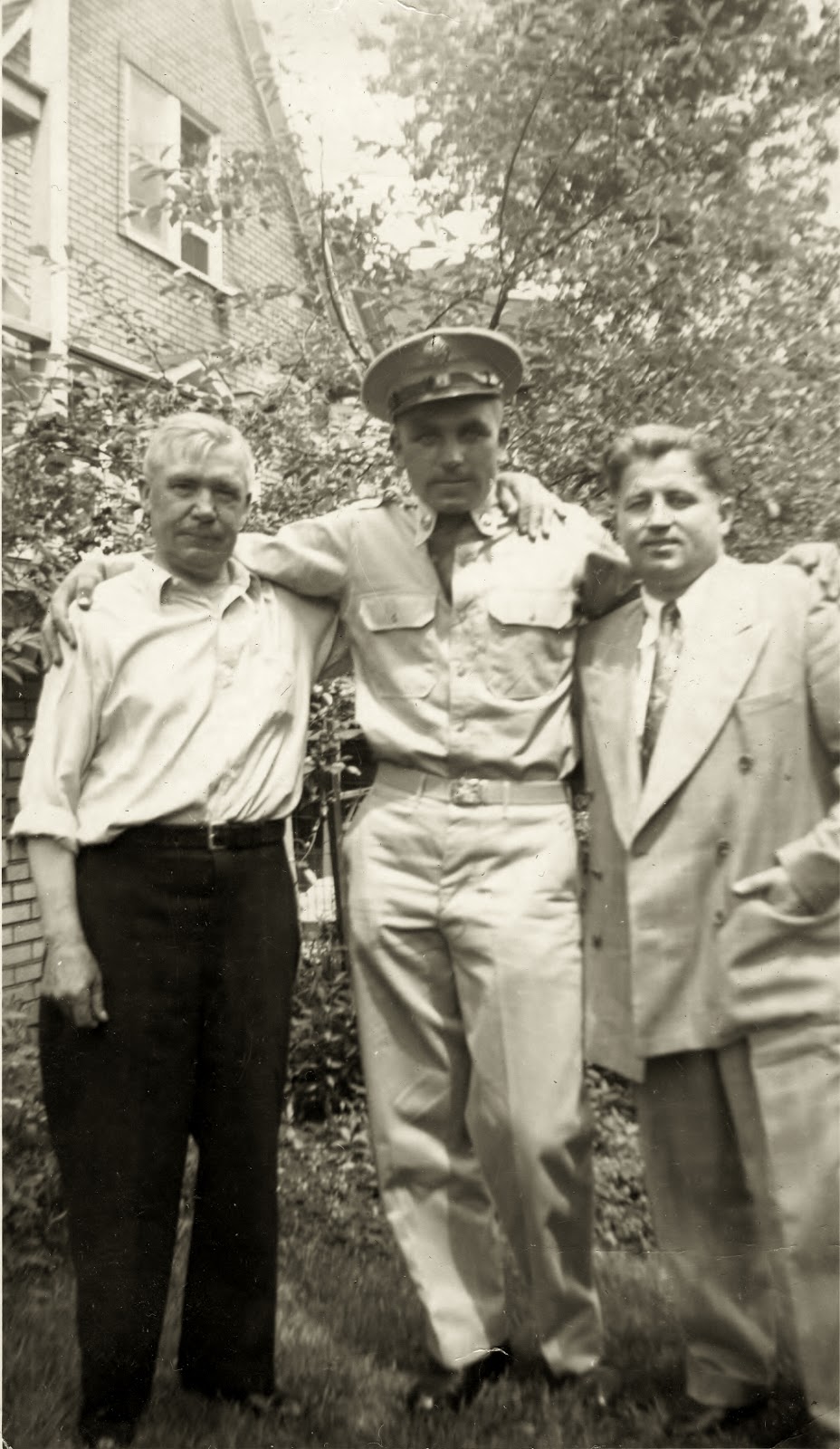
Brighton Park, Chicago, Illinois, 1951 or 1952. Mr. Irene's Dad returns to Chicago during a leave from the U.S. Army. The man on the left was one of Dad's immigration sponsors. The suited fellow on the right is the roommate of Dad's who died suddenly.
January 31, 2013
Related by Marriage: Men with Hats
Brighton Park, Chicago, about 1950. Mr. Irene's Dad and a cousin settle into American life. The cousin wears a jacket that members of my family called an "Eisenhower jacket."
December 10, 2012
The Arrival of the First Wavers
Or, "How Chicago became Lithuania's second capital."
Chicago's Public Television station, WTTW, also addressed the subject in "Lithuanians in Chicago," an episode in its "Chicago Stories" series.
Read more here about the first wavers on Mr. Irene's maternal side of the family.
Chicago's Public Television station, WTTW, also addressed the subject in "Lithuanians in Chicago," an episode in its "Chicago Stories" series.
Read more here about the first wavers on Mr. Irene's maternal side of the family.
Labels:
Anna,
Aunt M,
Bridgeport,
Brighton Park,
Chicago,
first wavers,
Immigration,
Lithuania,
Marquette Park,
Martha,
Mother-in-law,
Mr. Irene,
Petra,
Related by Marriage,
St. George's Parish,
Stanley,
stockyards,
VilNews
November 14, 2012
Related by Marriage: Duty calls.
Brighton Park, Chicago, Illinois, August 1950. Ignas, the older brother of Mr. Irene's Dad, stands—on the right—with friends who've arrived to wish Ignas well as he joins the U.S. Army.
October 29, 2012
Related by Marriage: First Apartment, Same Neighborhood
Throughout the 1950s and 1960s, many Lithuanian Displaced Persons lived, worked, and socialized within the radius of a few miles. This was true for new arrivals who settled in the neighborhoods of Brighton Park, Gage Park, Marquette Park, West Lawn, and Archer Heights. Those neighborhoods surrounded Midway Airport.
When Mr. Irene's Dad first arrived in Chicago in 1949, he lived in a boardinghouse just across the street from the family home of his sponsor. A first-wave Lithuanian woman owned the boarding house; she rented rooms and provided meals to second-wave, single men. A cousin of Mr. Irene's Dad, who fled Lithuania with Dad and his brother Ignas, lived just a few doors down with her husband and young daughter in rented rooms on the same block in Brighton Park, South Artesian, near 40th Street.
After completing his U.S. Army service in 1953, Mr. Irene's Dad returned to the same boardinghouse and eventually found work alongside fellow Lithuanian DPs in a factory that manufactured seats for Ford automobiles. The factory stood in a sprawling industrial district along 65th Street, between Cicero and Narraganset Avenues. Just a few blocks south along Cicero Avenue were other manufacturing neighbors like a Ford assembly plant (that became the Ford City Shopping Center in 1965), Tootsie Roll, Sweetheart Cup, and Cracker Jack.
Mr. Irene's Dad shared his room with an older fellow he had known in the Displaced Persons camp at Seligenstadt. In early 1956, while Mr. Irene's Dad was visiting his brother in Los Angeles, his roommate passed away in his sleep, presumably from a heart attack.
Brighton Park, Spring, 1956. Immaculate Conception Lithuanian Catholic Church. Mr. Irene's Dad, standing at the front, on the right, serves as a pallbearer for the funeral of his boarding house roommate. Many younger DPs, however, were not Immaculate Conception parishoners. Instead, they attended Sunday Mass at Holy Cross Parish near 46th and Woods, in the nearby Back of the Yards neighborhood.
Brighton Park, Chicago, Illinois, sometime between 1956 and 1957. Mr. Irene's Dad relaxes on the sofa in his new apartment. The flat stood behind a first-floor grocery store operated by the owners of the six-unit building, themselves recently arrived DPs. The apartment had two bedrooms and an ample, eat-in kitchen. Mr. Irene's Dad made good use of his Army mess-hall training: quick sales at the grocery store frequently prompted hearty pork chop dinners.
When Mr. Irene's Dad first arrived in Chicago in 1949, he lived in a boardinghouse just across the street from the family home of his sponsor. A first-wave Lithuanian woman owned the boarding house; she rented rooms and provided meals to second-wave, single men. A cousin of Mr. Irene's Dad, who fled Lithuania with Dad and his brother Ignas, lived just a few doors down with her husband and young daughter in rented rooms on the same block in Brighton Park, South Artesian, near 40th Street.
After completing his U.S. Army service in 1953, Mr. Irene's Dad returned to the same boardinghouse and eventually found work alongside fellow Lithuanian DPs in a factory that manufactured seats for Ford automobiles. The factory stood in a sprawling industrial district along 65th Street, between Cicero and Narraganset Avenues. Just a few blocks south along Cicero Avenue were other manufacturing neighbors like a Ford assembly plant (that became the Ford City Shopping Center in 1965), Tootsie Roll, Sweetheart Cup, and Cracker Jack.
Mr. Irene's Dad shared his room with an older fellow he had known in the Displaced Persons camp at Seligenstadt. In early 1956, while Mr. Irene's Dad was visiting his brother in Los Angeles, his roommate passed away in his sleep, presumably from a heart attack.
Brighton Park, Spring, 1956. Immaculate Conception Lithuanian Catholic Church. Mr. Irene's Dad, standing at the front, on the right, serves as a pallbearer for the funeral of his boarding house roommate. Many younger DPs, however, were not Immaculate Conception parishoners. Instead, they attended Sunday Mass at Holy Cross Parish near 46th and Woods, in the nearby Back of the Yards neighborhood.
* * * * *
Shortly after the funeral, Mr. Irene's Dad moved into his first apartment with another immigrant friend. The spacious flat was just a few blocks south of his old boardinghouse, near the intersection of 43rd and Campbell. Mr. Irene's Dad occupied that apartment until his wedding day.
* * * * *
Vytautas Grove, Chicago, Illinois, about 1957. Mr Irene's Dad and his apartment roommate chat in the parking lot during a Sunday picnic.
Labels:
1956,
1957,
1960s,
Brighton Park,
death,
Displaced Persons,
Father-in-law,
first wavers,
Ford,
funerals,
Immigration,
landlady,
Marquette Park,
Midway Airport,
Mr. Roommate,
Related by Marriage,
stockyards,
Sundays
August 27, 2012
Related by Marriage: Three Suits
Brighton Park, Chicago, Illinois, about 1949 or 1950. Mr. Irene's Dad (left) and his brother, Ignas (right), stand with Ignas's best friend near the home of the Americans who sponsored their postwar immigration to the United States.
August 10, 2012
Related by Marriage: A New Arrival in Chicago
Brighton Park, Chicago, Illinois, Winter 1950. Mr. Irene's Dad gets introduced to Chicago and to its winters. If you've been to Brighton Park, then this street scene is familiar to you.
February 21, 2012
Related by Marriage: The Barracks
Mr. Irene's Dad sent this photo to his brother, Ignas. The snapshot shows Mr. Irene's Dad on his bunk at the army base.
Camp Irwin, Barstow, California, March 22, 1952. Mr. Irene's Dad wrote, "Brother—I am sitting on my bed, reading the newspaper."
Mr. Irene's Dad enjoys a smoke as he reads the Chicago-based Lithuanian newspaper, "Draugas." Mr. Irene's Dad probably has returned to his corner in the barracks after another work day teaching people how to drive tanks.
I don't know who the woman is in the forget-me-not portrait, but Mr. Irene's Dad has displayed that formal portrait of himself on the shelf. There's a stack of "Draugas" newspapers on the shelf; Mr. Irene's Dad also has tucked a carton of Lucky Strikes under the newspapers.
Thanks to Mr. Irene's Los Angeles Cousin for making this photograph available to us.
Camp Irwin, Barstow, California, March 22, 1952. Mr. Irene's Dad wrote, "Brother—I am sitting on my bed, reading the newspaper."
Mr. Irene's Dad enjoys a smoke as he reads the Chicago-based Lithuanian newspaper, "Draugas." Mr. Irene's Dad probably has returned to his corner in the barracks after another work day teaching people how to drive tanks.
I don't know who the woman is in the forget-me-not portrait, but Mr. Irene's Dad has displayed that formal portrait of himself on the shelf. There's a stack of "Draugas" newspapers on the shelf; Mr. Irene's Dad also has tucked a carton of Lucky Strikes under the newspapers.
Thanks to Mr. Irene's Los Angeles Cousin for making this photograph available to us.
Labels:
1952,
barracks,
Barstow,
Brighton Park,
California,
Camp Irwin,
Draugas,
Father-in-law,
Ignas,
Immigrants,
Los Angeles Cousin,
Mr. Irene,
Related by Marriage,
Smoking,
U.S. Army,
uniforms
January 1, 2012
Related by Marriage: Arriving in Chicago
After Mr. Irene's Father reached New York City, he spent only a few hours at the port before boarding a train for Chicago.
The immigration personnel processed my Father-in-Law and his traveling companions quickly. Mr. Irene's father recalls that the officials telephoned the immigrants' sponsors to ensure that legal parties would be available to meet the new arrivals. While the group waited for these verifications, one of the travelers developed a taste for herring. He asked a porter at the shipyard to go on a "herring run" so that the group would have a taste of home before they traveled west. The porter complied, and my Father-in-Law enjoyed a plate of herring right before he left for Chicago.
Brighton Park, Chicago, June 1949. Mr. Irene's Father, standing on the pavement at the left, joins his brother, Ignas, on the steps and also on the left, and their sponsors shortly after arriving in Chicago.
The immigration personnel processed my Father-in-Law and his traveling companions quickly. Mr. Irene's father recalls that the officials telephoned the immigrants' sponsors to ensure that legal parties would be available to meet the new arrivals. While the group waited for these verifications, one of the travelers developed a taste for herring. He asked a porter at the shipyard to go on a "herring run" so that the group would have a taste of home before they traveled west. The porter complied, and my Father-in-Law enjoyed a plate of herring right before he left for Chicago.
Brighton Park, Chicago, June 1949. Mr. Irene's Father, standing on the pavement at the left, joins his brother, Ignas, on the steps and also on the left, and their sponsors shortly after arriving in Chicago.
Labels:
1949,
Atlantic Ocean,
Brighton Park,
Chicago,
Displaced Persons,
Family,
fashion,
Father-in-law,
Food,
Ignas,
Immigrants,
Mr. Irene,
New York,
Related by Marriage,
sponsors,
steps,
train,
Travel
December 23, 2011
Related by Marriage: Meet the Butcher
Mr. Irene and I visited an upscale grocery store today to pick up some additional items for our Kūčios table. We stopped at the meat counter to look at some of the unusual sausages for sale. While there, we asked the butcher whether he carried any potato sausages. A coworker asked the butcher what potato sausages were, and the butcher paused, explaining that they were a "Swedish" food. When Mr. Irene and I burst out that Lithuanians eat potato sausages too, the butcher laughed and told us that he, too, is Lithuanian.
It was nice to meet you today, butcher Paul. This post is for you.
Mr. Irene's maternal Grandfather, Stanley, was a Lithuanian butcher. For a time, he ran a butcher shop and small grocery store in Brighton Park, near the intersection of 44th and Fairchild. He owned the place for about ten years, but it went under during the Great Depression. In the mid-1930s, Stanley began working for Benjamin Moore, which then had a plant on Chicago's South Side. When Benjamin Moore relocated its operation to suburban Melrose Park, Stanley continued to work for the company, commuting daily from his home in Marquette Park.
After Mr. Irene's Parents married, Stanley helped Mr. Irene's Dad get a job at Benjamin Moore. My Father-in-Law mixed paint at Benjamin Moore for over thirty-five years.
When Stanley retired from Benjamin Moore, he again worked as a butcher, this time on a part-time basis in a Marquette Park shop.
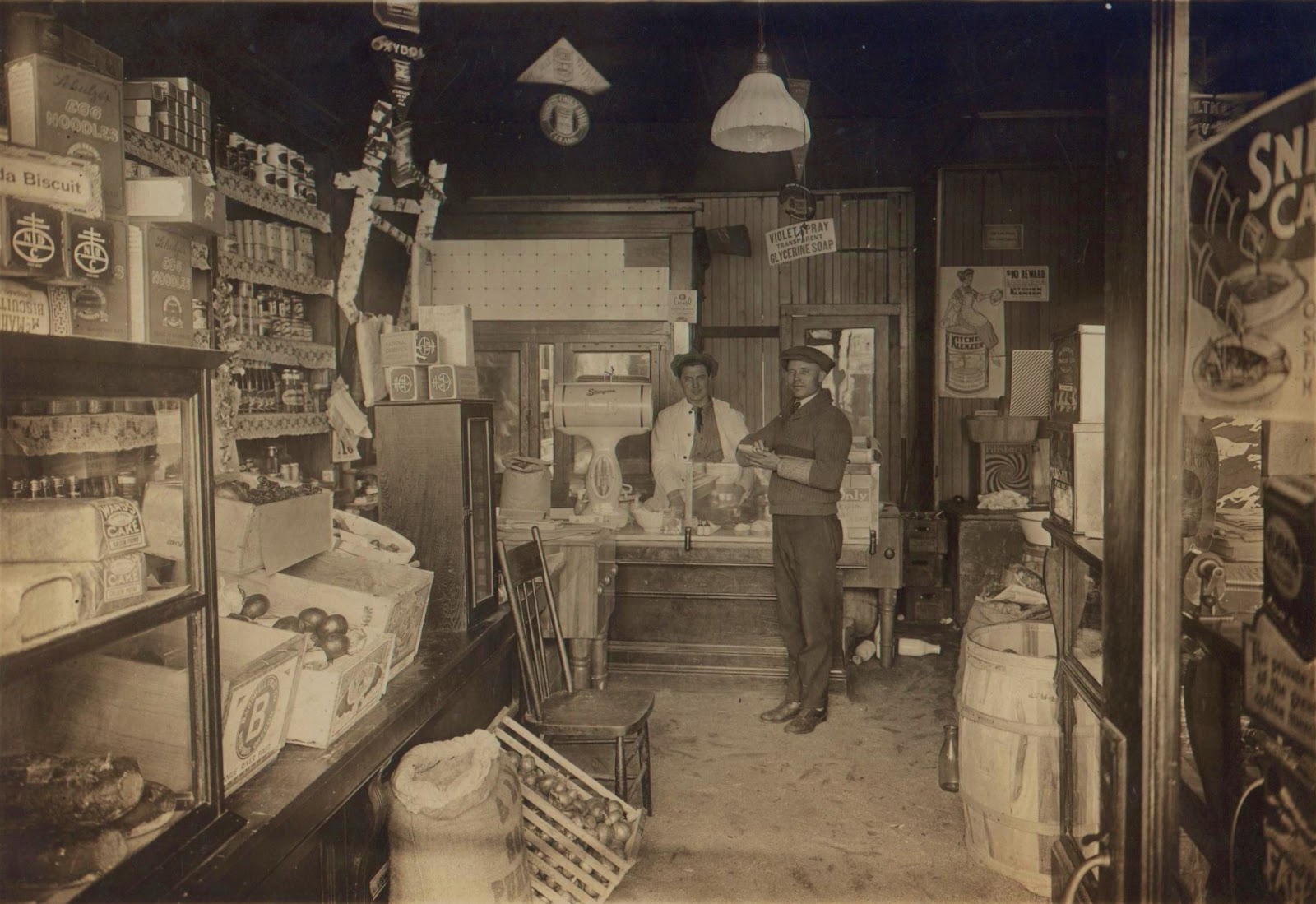
Brighton Park, Chicago, 1925. Mr. Irene's maternal Grandfather, Stanley, stands behind the counter of the butcher shop. The man on the counter's other side is a distributor, and the men posed for this photo to commemorate the distributor's visit.
It was nice to meet you today, butcher Paul. This post is for you.
Mr. Irene's maternal Grandfather, Stanley, was a Lithuanian butcher. For a time, he ran a butcher shop and small grocery store in Brighton Park, near the intersection of 44th and Fairchild. He owned the place for about ten years, but it went under during the Great Depression. In the mid-1930s, Stanley began working for Benjamin Moore, which then had a plant on Chicago's South Side. When Benjamin Moore relocated its operation to suburban Melrose Park, Stanley continued to work for the company, commuting daily from his home in Marquette Park.
After Mr. Irene's Parents married, Stanley helped Mr. Irene's Dad get a job at Benjamin Moore. My Father-in-Law mixed paint at Benjamin Moore for over thirty-five years.
When Stanley retired from Benjamin Moore, he again worked as a butcher, this time on a part-time basis in a Marquette Park shop.
Brighton Park, Chicago, 1925. Mr. Irene's maternal Grandfather, Stanley, stands behind the counter of the butcher shop. The man on the counter's other side is a distributor, and the men posed for this photo to commemorate the distributor's visit.
Labels:
1925,
Benjamin Moore,
Brighton Park,
Father-in-law,
first wavers,
Food,
Illinois,
Marquette Park,
Melrose Park,
Mother-in-law,
Mr. Irene,
Related by Marriage,
shopping,
Stanley,
stockyards,
work
December 8, 2011
Related by Marriage: You're in the Army!
Mr. Irene's Dad—"Father-in-Law"—was younger than my Parents. When he sailed to the United States in June, 1949, he still was an unmarried man. Father-in-Law, like all Displaced Persons who arrived in America, had the "sponsorship" of a U.S. citizen. A sponsor ensured that the new arrival would have housing, would not displace any American workers, and generally would stay out of trouble. Father-in-Law's sponsor was a distant relative whose family had settled in Chicago as part of the first wave of Lithuanian immigrants.
Father-in-Law initially settled in Brighton Park, a south-side, Lithuanian enclave similar to Marquette Park. Because he lived in Brighton Park, Father-in-Law had few opportunities to speak English. He carried out his work life and his social life in the Lithuanian language.
Father-in-Law got an unexpected notice about twenty months after he emigrated to the States. The U.S. Army had drafted him. The Korean War was under way, and the U.S. Army stationed Father-in-Law at the base in Barstow, California as … a tank instructor. This life change meant that Father-in-Law learned English rather quickly. He hung around with a bunch of privates, and his closest buddy was a cook in the mess hall. Father-in-Law learned Army-base English.
Father-in-law was eager to show his sponsor's family how proficiently he had absorbed the nuances of the English language. On leave for Thanksgiving, he headed home to Brighton Park. Sitting at the holiday table, and midway through the meal, Father-in-Law asked, "Would someone please pass the fucking potatoes?"
The stint in the U.S. Army had additional benefits. First, the timeline for Father-in-Law's naturalization process sped up because of his service in the military. Second, as a Korean War vet, Father-in-Law qualified to join the V.F.W. It was at a V.F.W.-sponsored event that Father-in-Law first met Mr. Irene's Mom.
Camp Irwin, Barstow, California, February 16, 1951. Father-in-Law looks happy.
Father-in-Law initially settled in Brighton Park, a south-side, Lithuanian enclave similar to Marquette Park. Because he lived in Brighton Park, Father-in-Law had few opportunities to speak English. He carried out his work life and his social life in the Lithuanian language.
Father-in-Law got an unexpected notice about twenty months after he emigrated to the States. The U.S. Army had drafted him. The Korean War was under way, and the U.S. Army stationed Father-in-Law at the base in Barstow, California as … a tank instructor. This life change meant that Father-in-Law learned English rather quickly. He hung around with a bunch of privates, and his closest buddy was a cook in the mess hall. Father-in-Law learned Army-base English.
Father-in-law was eager to show his sponsor's family how proficiently he had absorbed the nuances of the English language. On leave for Thanksgiving, he headed home to Brighton Park. Sitting at the holiday table, and midway through the meal, Father-in-Law asked, "Would someone please pass the fucking potatoes?"
The stint in the U.S. Army had additional benefits. First, the timeline for Father-in-Law's naturalization process sped up because of his service in the military. Second, as a Korean War vet, Father-in-Law qualified to join the V.F.W. It was at a V.F.W.-sponsored event that Father-in-Law first met Mr. Irene's Mom.
Camp Irwin, Barstow, California, February 16, 1951. Father-in-Law looks happy.
Labels:
1949,
1951,
Barstow,
Brighton Park,
California,
Camp Irwin,
Displaced Persons,
Displaced Persons Act of 1948,
Father-in-law,
Mother-in-law,
Mr. Irene,
Related by Marriage,
U.S. Army,
uniforms,
V.F.W.
Subscribe to:
Posts (Atom)