Marquette
Park, Chicago, Illinois, Winter 1950-1951. Mr. Irene visits his sponsors'
neighborhood not long after his
arrival in the United States.
Showing posts with label sponsors. Show all posts
January 22, 2014
December 3, 2013
Related by Marriage: Stamp Collection
In
the spring and summer of 1949, Lithuanian Displaced Persons began
arriving in Chicago. The Displaced
Persons Act of 1948 had temporarily opened the U.S. to the refugees
from the Baltic states and other countries fleeing Soviet occupation of their
countries. Between 1949 and 1951, only Polish immigrants outnumbers the Lithuanian DPs arriving in Chicago.
Both family members and charitable organizations hosted the new arrivals. Immigrants frequently relied on local, Lithuanian parishes to provide a social structure. Among the new arrivals were many young, unmarried adults. Organizations like the Catholic Knights of Lithuania provided a year-round calendar of events that introduced first generation Lithuanian-Americans to the DPs in their age groups. (Mr. Irene’s parents celebrated their wedding at the Knights of Lithuania Hall on 47th Street in Brighton Park.)
Mr.
Irene’s Mom took part in the Knights' social culture. She recalls that the
young bachelors "from the old country" were more charming and
interesting than her Chicago-born friends.
Agnes,
an aunt of Mr. Irene’s Mom, and her husband sponsored two young bachelors and
one family. Mr. Irene’s Mom briefly dated one
of the DP bachelors. She had recently
moved with her family from Bridgeport to Marquette Park. The bachelor
gave Mr. Irene's Mom a memento from his time in the Würzburg DP camp. It was
a display book that held stamps issued in late 1930s Lithuania, wartime
Germany, and the immediate postwar period in the DP camps.
Würzburg
Displaced Persons Camp, Germany, November, 1947. This page shows a variety of
German postage stamps issued in 1944.
One series illustrated local festivals, such as a shooting competition
in Innsbruck in July, 1944. Others
pictured "Heroes," ranging from stylized military scenes to idyllic images
of youth and family.
* * * * *
Würzburg,
Displaced Persons Camp, Germany, November, 1947. These stamps feature
anniversary illustrations of the Lithuania's 1918
independence and commemoration of the trans-Atlantic flight of pilots Darius
and Girenas that opened Lithuania’s international air mail service. The
Lithuanian Red Cross issued the Camp Meerbeck stamps in the British Zone of
postwar Germany in 1947, observing the 400th anniversary of Lithuanian book
printing. Note the British stamps highlighting the 1948 Olympics and 25th
anniversary of the King’s reign.
Labels:
1947,
1949,
Agnes,
Brighton Park,
Displaced Persons,
Displaced Persons Act of 1948,
Immigration,
Marquette Park,
mementos,
Mother-in-law,
Olympics,
Related by Marriage,
sponsors,
stamps,
World War II
November 15, 2013
"We're on the swaying boat."
That's what a friend of my maternal Grandfather, Jake, wrote on the back of this photo:
Atlantic Ocean, May 9, 1949. This is the woman whose family settled on a farm in Howard Lake.
November 9, 2013
Where to settle.
Many
Displaced Persons seeking to relocate to the United States did not have family who
could sponsor
their immigration. Those refugees instead relied on churches or other, unrelated,
sponsors. Unrelated sponsors often contracted to support an immigrant on
condition that the new arrival work for them for a period of time. This system—though
not a government program—was similar to the relocation structure that operated
in in
Canada. My paternal Grandmother Tatjana, for example, worked
as a cook in the home of a Russian
family. Other Displaced Persons lived and worked on farms after their
arrival.
Howard Lake, Minnesota, May 21, 1950. A friend of my maternal Grandfather, Jake, wrote, "Here you can see our boss's farm."
July 13, 2013
Adjusted
Brighton Park, Chicago, Illinois, 1949. The family of Mr. Irene's Dad settled into a new life shortly after arriving in Chicago. Here, Uncle D—my Father-in-law's maternal uncle—visits with the family's sponsor and the sponsor's wife. Uncle D's wife, Danutė, sits on the far right. (Did you see a "flat-screen TV" when you first looked at this photo?)
Thanks to Mr. Irene's Los Angeles Cousin for making this photo available to us.
Labels:
1949,
assimilation,
Brighton Park,
Chicago,
Danutė,
decorating,
Displaced Persons,
Father-in-law,
Illinois,
Immigration,
Los Angeles Cousin,
modern life,
Related by Marriage,
sponsors,
television,
Uncle D
April 2, 2013
March 20, 2013
Related by Marriage: On Leave
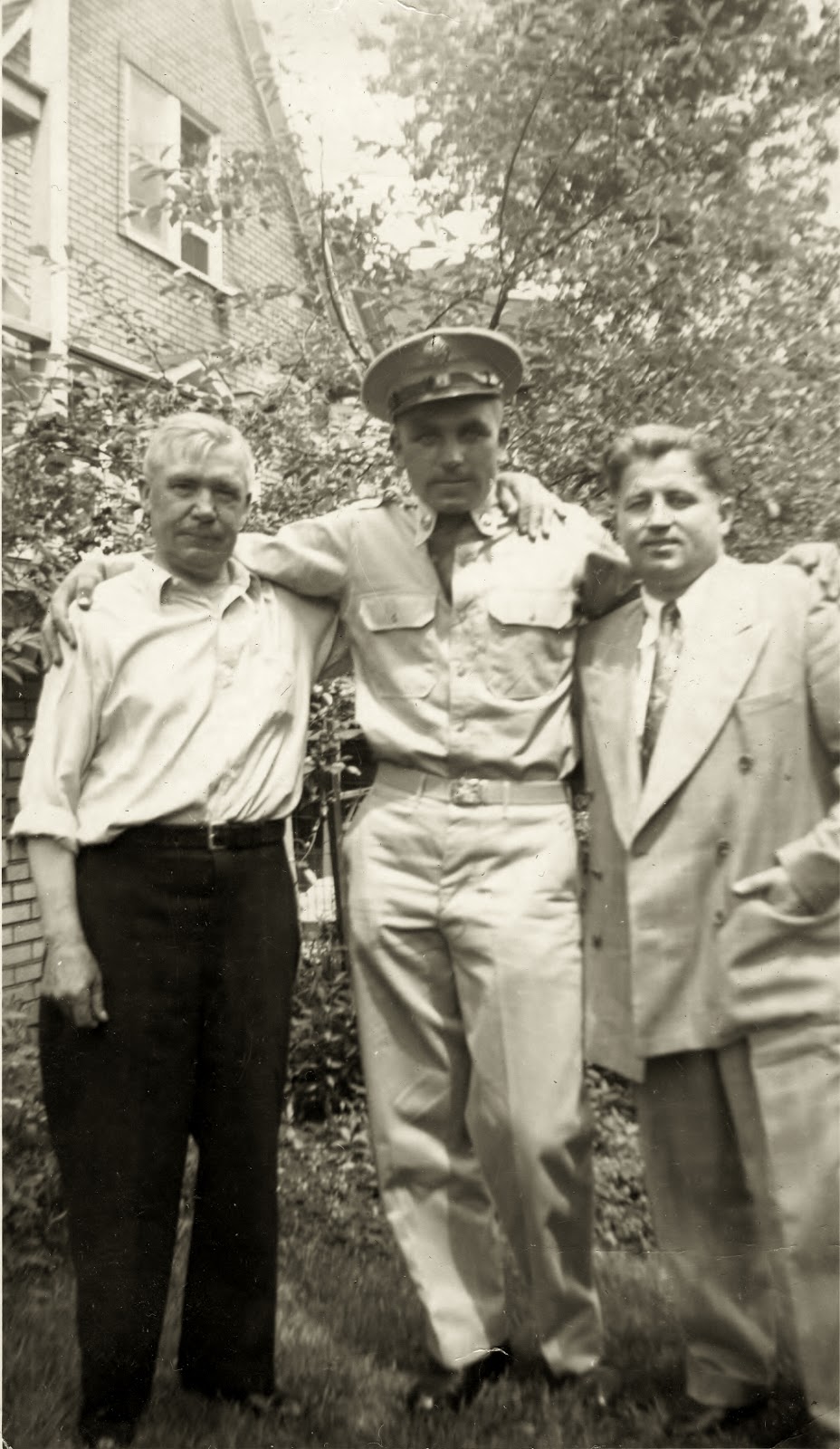
Brighton Park, Chicago, Illinois, 1951 or 1952. Mr. Irene's Dad returns to Chicago during a leave from the U.S. Army. The man on the left was one of Dad's immigration sponsors. The suited fellow on the right is the roommate of Dad's who died suddenly.
March 16, 2013
Related by Marriage: Millie
Chicago, Illinois, January 23, 1946. Millie was a daughter of the uncle who sponsored Mr. Irene's Dad's immigration to the United States.
February 28, 2013
Related by Marriage: A Second Arrival
Postwar Germany, March 11, 1949. This is Ignas, Mr. Irene's paternal Uncle, shortly before Ignas emigrated to the United States. Ignas wrote a summary of this period:
On June 18, 1949, I arrived in Chicago. My brother [Mr. Irene's Dad] had already arrived one week before me. We were very warmly welcomed and received by [our sponsor's] family. ...
The following week I got a job at a carpet warehouse. I could read and write in English, but could not pronounce the words. It was almost a month before I could have a decent conversation with coworkers. The work was interesting, but I had to learn how to lift heavy objects. In the fall I began going to night school at Inglewood High School to learn English. During this same time the Lithuanian organization “Ateitis” was re-established in Chicago. We even started a Lithuanian folk dance group.
August 27, 2012
Related by Marriage: Three Suits
Brighton Park, Chicago, Illinois, about 1949 or 1950. Mr. Irene's Dad (left) and his brother, Ignas (right), stand with Ignas's best friend near the home of the Americans who sponsored their postwar immigration to the United States.
April 28, 2012
Related by Marriage: New Ties
Marquette Park, Chicago, Winter 1950-1951. Mr. Irene's Dad—in the coat and hat—joins his brother, Ignas—newly drafted into the U.S. Army—for a snapshot with the wife of the man who sponsored the brothers' immigration to the United States.
Thanks to Mr. Irene's Los Angeles Cousin for making this photo available to us.
Labels:
1950,
1951,
Chicago,
coat,
Displaced Persons,
Father-in-law,
hands-on-hips,
hats,
Ignas,
Immigration,
Los Angeles Cousin,
Marquette Park,
Mr. Irene,
Related by Marriage,
sponsors,
uniforms
April 16, 2012
Related by Marriage: California Wedding
Mr Irene's Uncle Ignas met his future wife, Ellie, in the Lithuanian Displaced Persons camp in Würzburg in July, 1946. Ignas had just reached Würzburg in June, finally reuniting with his brother, Mr Irene's Dad. The two saw each other for the first time since they had fled the advancing Soviet Army in July, 1944.
Ellie was in Würzburg with her Parents. She was a scoutmaster for a troop of young girls. Ellie met Ignas at a campfire social, and they developed a quick and close friendship.
By January 1949, Ellie's family received an invitation to settle in Los Angeles, where Ellie's mother had a distant relative. Ignas and Mr. Irene's Dad emigrated to Chicago in June 1949, to settle with their sponsor, a first-waver uncle who had emigrated from Lithuania before World War I.
Ignas and Ellie corresponded, and Ellie had hoped to join Ignas in Chicago. One year later, the start of the Korean War interrupted those plans. The U.S Army drafted Ignas, and Ignas reported for duty in Fort Campbell, Kentucky, on August 22, 1950.
In January, 1952, while on leave in Los Angeles, Ignas proposed to Ellie. They married after Ignas's discharge in October, 1952, and they settled in California.
A pastor tried to convince Mr Irene's Dad to settle in Los Angeles too, but after his discharge from the U.S. Army, Mr Irene's Dad returned to Chicago.
Los Angeles, California, October 1952. Ignas and Ellie were the first couple to be married in the new Lithuanian parish church, St Casimir's, which had opened in 1951. Mr Irene's Dad—on the far left—was the best man at the wedding. Mr. Irene's Dad was still in the U.S. Army at the time, stationed not too far away at Camp Irwin, in Barstow.
Ellie was in Würzburg with her Parents. She was a scoutmaster for a troop of young girls. Ellie met Ignas at a campfire social, and they developed a quick and close friendship.
By January 1949, Ellie's family received an invitation to settle in Los Angeles, where Ellie's mother had a distant relative. Ignas and Mr. Irene's Dad emigrated to Chicago in June 1949, to settle with their sponsor, a first-waver uncle who had emigrated from Lithuania before World War I.
Ignas and Ellie corresponded, and Ellie had hoped to join Ignas in Chicago. One year later, the start of the Korean War interrupted those plans. The U.S Army drafted Ignas, and Ignas reported for duty in Fort Campbell, Kentucky, on August 22, 1950.
In January, 1952, while on leave in Los Angeles, Ignas proposed to Ellie. They married after Ignas's discharge in October, 1952, and they settled in California.
A pastor tried to convince Mr Irene's Dad to settle in Los Angeles too, but after his discharge from the U.S. Army, Mr Irene's Dad returned to Chicago.
Los Angeles, California, October 1952. Ignas and Ellie were the first couple to be married in the new Lithuanian parish church, St Casimir's, which had opened in 1951. Mr Irene's Dad—on the far left—was the best man at the wedding. Mr. Irene's Dad was still in the U.S. Army at the time, stationed not too far away at Camp Irwin, in Barstow.
Labels:
1952,
Barstow,
California,
Camp Irwin,
Displaced Persons,
Ellie,
Father-in-law,
first wavers,
folkdress,
Ignas,
Los Angeles,
Related by Marriage,
scouting,
sponsors,
U.S. Army,
wedding,
Würzburg
March 5, 2012
Related by Marriage: Two Who Mattered
These two men were "first wavers" who emigrated to Chicago from Lithuania before the fall of Tsarist Russia. After World War II, first wavers often were the ones who made it possible for Displaced Persons to relocate to the United States. Under the Displaced Persons Act of 1948, a World War II refugee could not settle in the U.S. unless someone "sponsored" him.
"First wavers" often stepped up to serve as sponsors.
South Side Chicago, about 1955. The man on the left is an uncle who served as the sponsor for the immigration of Mr. Irene's Dad. On the right stands the brother of Mr. Irene's Great-Grandfather.
"First wavers" often stepped up to serve as sponsors.
South Side Chicago, about 1955. The man on the left is an uncle who served as the sponsor for the immigration of Mr. Irene's Dad. On the right stands the brother of Mr. Irene's Great-Grandfather.
January 1, 2012
Related by Marriage: Arriving in Chicago
After Mr. Irene's Father reached New York City, he spent only a few hours at the port before boarding a train for Chicago.
The immigration personnel processed my Father-in-Law and his traveling companions quickly. Mr. Irene's father recalls that the officials telephoned the immigrants' sponsors to ensure that legal parties would be available to meet the new arrivals. While the group waited for these verifications, one of the travelers developed a taste for herring. He asked a porter at the shipyard to go on a "herring run" so that the group would have a taste of home before they traveled west. The porter complied, and my Father-in-Law enjoyed a plate of herring right before he left for Chicago.
Brighton Park, Chicago, June 1949. Mr. Irene's Father, standing on the pavement at the left, joins his brother, Ignas, on the steps and also on the left, and their sponsors shortly after arriving in Chicago.
The immigration personnel processed my Father-in-Law and his traveling companions quickly. Mr. Irene's father recalls that the officials telephoned the immigrants' sponsors to ensure that legal parties would be available to meet the new arrivals. While the group waited for these verifications, one of the travelers developed a taste for herring. He asked a porter at the shipyard to go on a "herring run" so that the group would have a taste of home before they traveled west. The porter complied, and my Father-in-Law enjoyed a plate of herring right before he left for Chicago.
Brighton Park, Chicago, June 1949. Mr. Irene's Father, standing on the pavement at the left, joins his brother, Ignas, on the steps and also on the left, and their sponsors shortly after arriving in Chicago.
Labels:
1949,
Atlantic Ocean,
Brighton Park,
Chicago,
Displaced Persons,
Family,
fashion,
Father-in-law,
Food,
Ignas,
Immigrants,
Mr. Irene,
New York,
Related by Marriage,
sponsors,
steps,
train,
Travel
Subscribe to:
Posts (Atom)