Showing posts with label finger wag. Show all posts

August 2, 2013

The Life Box (Part 10)

Beginning in the second grade, I started to hear stories about Sister J, a fourth-grade teacher who had a severe reputation. I had witness short-tempered teachers already since first grade, but older children reported that Sister J was the sharpest disciplinarian at the school. 

I was rattled when I learned Sister J would be my teacher. Sister J lived up to my fearful expectations. When students misbehaved, Sister J finger wagged and slapped a ruler. Once, I'd been out sick (really sick) for almost a week, and I missed the lessons about memorizing the multiplication table. When I returned to class, Sister J called me up to the front of the room and demanded that I draw and recite the table. I didn't know what to do, so I stood silent. Sister J slammed my head against the blackboard.
 
Sister J assigned one interesting project for our social studies unit. She required each student to prepare a report about a foreign country. I chose Austria, and here is my report:


*     *     *     *     *


Catholic-school alumni will recognize the "JMJ" at the top of most pages.

*     *     *     *     *


*     *     *     *     *


*     *     *     *     *


*     *     *     *     *


(I cite my sources.)

*     *     *     *     *


*     *     *     *     *


(I was using a blank line to separate paragraphs.)

*     *     *     *     *


*     *     *     *     *    


*     *     *     *     *

After I finished the fourth grade, I didn't see Sister J for another six years. She showed up at the funeral mass of my paternal Grandmother, Tatjana. Sister J gave me a sympathy card and a nosegay of flowers.

July 22, 2013

General Manners: Pause before you "finger wag."


Suburban Chicago, April 1961. I hold back my finger wag because Dad is taking a picture of me and my babysitter.

(Did you think I had forgotten about the "General Manners" series?)

June 22, 2013

What did I see?


Suburban Chicago, May 1961. I've riden a short distance from the driveway, and this time, I am not wagging my finger. Here, I might be pointing at our neighbors' dog, Mikey—or maybe at their cat.

May 14, 2012

Thanks for lunch.

I spent some delightful time today with a friend who likes cameloids.


Brookfield Zoo, March 1970. I reprimand the llamas because they refuse to share my treats.

May 5, 2012

Dora is back.

Last night, as we prepared for our "three-dog-night" bedtime routine, my Mom came upstairs, as she usually does, to lend a hand with the pups. Yesterday she carried two envelopes with her, up to the dining room. The envelopes contained photos I had never seen. It was another "eureka moment," when an unexpected cache of photos appears in the house. Coincidentally, Mr. Irene visited his folks yesterday, and they, too, produced a few folders of "new" old snapshots.

I thought I had ferreted out all of the old family photos. I don't want the stream of old photos to end. But I've also considered how this blog will evolve when the old images all have been posted. I am delighted when I can postpone transformations.

So here is Dora, coaxing her little doggie to stay in the beg position:


Kaunas, Lithuanian Soviet Socialist Republic, September 10, 1959. Dora writes,"I am wearing the taffetta dress with 'Pupkė,' our little dog. But this is a weak photo. I look much better in real life."

(We have named two of our dogs, Pupa and Poppy, after the term "'Pupkė," a common Lithuanian word of endearment. My Mom, for example, still calls me "Pupulė.")

March 1, 2012

Frustrations

Amber Reunion experienced some technical frustrations today. I was ready to walk away and neglect my self-imposed "post quota."

But I am a stubborn hag. So I did a jig, popped a finger wag, and basta. We are back in business.


Suburban Chicago, March 1964. I dance to shake out the pre-bedtime frustrations.

*     *     *     *     *


Suburban Chicago, March 1964. I've learned the finger-wag gesture from Tatjana. That maneuver, if pointed towards a Parent, will really send me to bed.

January 7, 2012

Dog House

My paternal Grandmother, Tatjana, was not initially happy when we acquired a dog.

Here is how Tatjana reacted when she first met Gigi:


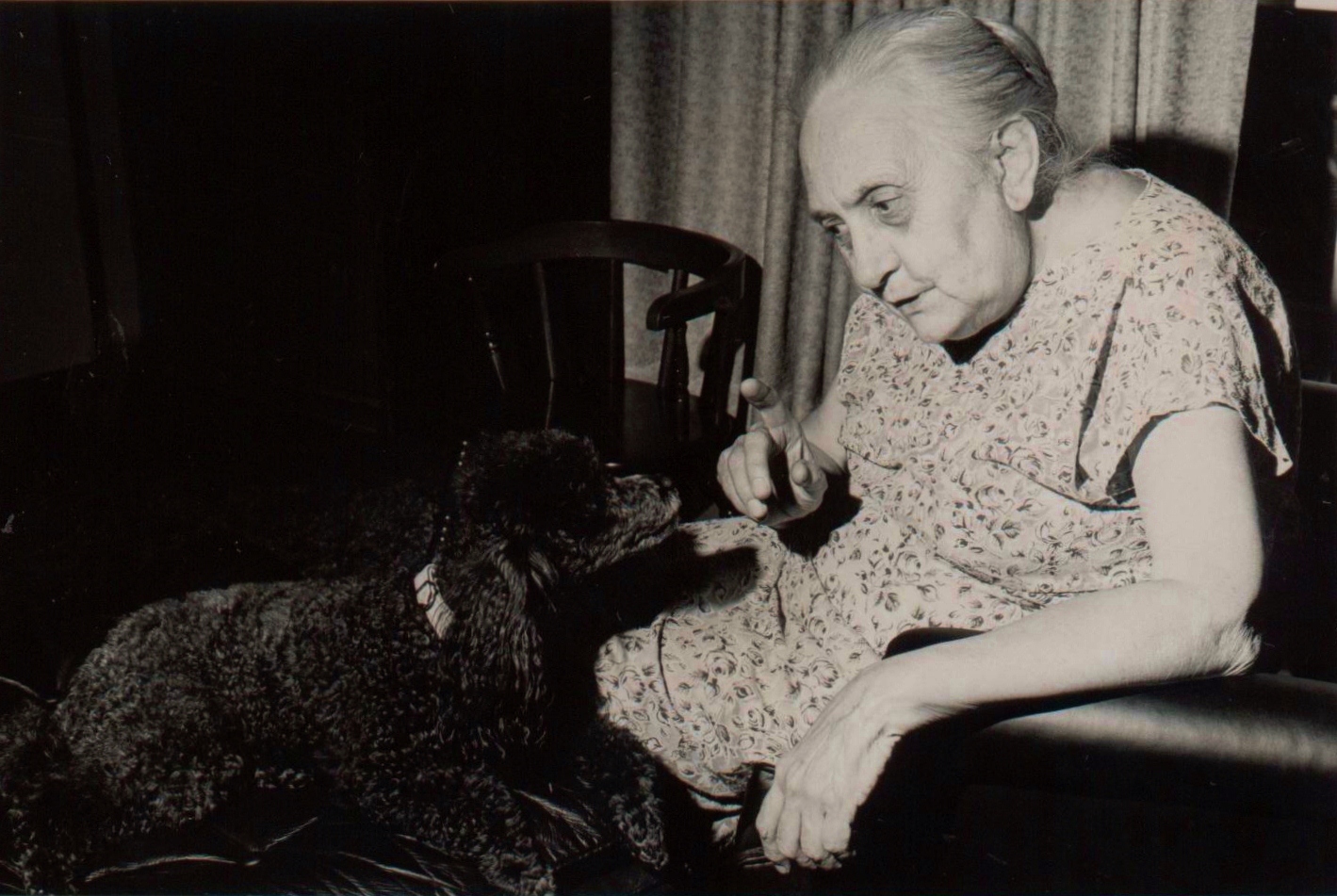
Suburban Chicago, September 1969. Gigi tries to make friends with Tatjana. Tatjana is skeptical.

*     *     *     *     *

Tatjana apparently thought the "Alpha Baba" finger wag would intimidate a dog:


Suburban Chicago, September 1969. Gigi interprets the finger wag as a gesture worthy of a sniff.

December 27, 2011

A Mild December

It's been unseasonably warm here so far this winter. The moderate temperatures even made it possible to spend more time outdoors.


Suburban Chicago, May 1961. I express an opinion as I circle the driveway.

UPDATE: In the comments, usoniaboy writes, "That's the same finger your grandmother used to show her displeasure... "

I agree. It's exactly the same gesture.

December 7, 2011

Alpha Baba

My paternal Grandmother, Tatjana, was no wallflower. Although our "Baba" usually was cuddly and soft—inside and out—sometimes she revealed her canyons of hardship.

Tatjana occasionally articulated her resolve by wagging her finger. This could be bad or good. For example, she often delivered the gesture as a threat—"Wait till your Mother gets home" or "I'll leave if I don't get my way." At other times, she used it as an affectionate softener when she offered sage, but unsolicited, advice—"I told you so."

I couldn't distinguish between the two finger-wagging genres when I was a kid: the wagging finger always sent me flying.

This photo likely illustrates the good, "See, I'm older and smarter than you," kind of delivery:


Suburban Chicago, December 1970. Fire in those melancoly eyes: Tatjana drives home a point while talking to my Godfather.

November 18, 2011

Renaissance Man

Like his daughter Dora, my Great-Grandfather Silvestras was an intriguing character. Had he been born in my generation, then Silvestras would have been a visionary innovator poised on the edge of technological genius.

We aren't certain how Silvestras—literally—came to win Zigmunta's hand. Despite the peculiar start to their marriage, Silvestras and Zigmunta raised three children together: Edvardas, who died of a ruptured appendix on the cusp of his thirtieth birthday; my maternal Grandmother, Jadzė, who fell to cancer in her early forties, and; Dora, who lived into her mid-nineties, and who died one year after Lithuania regained its independence.

Silvestras first worked in a high school as a music and piano teacher. That profession grew less attractive once Silvestras saw that students don't take music and art teachers seriously. One afternoon—probably in the late 1920s—pupils started pummeling Silvestras with paper airplanes as he sat at his piano bench, his back to the class. That was the last day he taught in a school.

Silvestras then devoted the remainder of his career to piano tuning and repair.

My Mom spent summer vacations in Mariampolis, Lithuania, at the home of her Grandparents. She has textured memories of Silvestras. Silvestras grew his own tobacco. He dried the harvested leaves in the attic. On summer days, Silvestras sat at the dining room table methodically clipping the dried tobacco while he read Jules Verne's Around the World in Eighty Days aloud to my Mom.

Silvestras, like many Lithuanian men, exceled in the folk art of woodcarving. He created toys for my Mom and often crafted walking sticks—another form native art. Silvestras once carved a "špyga," a crude hand gesture, onto the head of a walking stick. Rattling a špyga is equivalent to "giving the finger" in the United States. When someone agitated Silverstras, Silvestras shook the walking stick in the offender's face, thereby avoiding making the impolite gesture himself.

Silvestras carved a violin. He also designed and built a working thermometer and barometer that seems to have been modeled on a cuckoo clock. When the weather was sunny, two wooden children would emerge from the device carrying flower bouquets. When it rained, they stepped out with umbrellas over their heads.

Finally, Silvestras was a master gardener. He grafted branches so that different varieties of fruit would mature on the same tree. Silvestras grew wonderful apples from which he fermented a sweet wine. He even kept a bee hive, and he designed a centrifuge to collect the honey.

Silvestras traveled alone in 1941 to spend Christmas with my Mom's family in Kaunas. Silvestras was in his mid-eighties, and the Nazis had just begun their occupation of Lithuania. Silvestras fell ill and, without antibiotics available to assist him, he acquired pneumonia and died.


Mariampolis, Lithuania, December 24, 1936. My Mom's maternal Grandfather, Silvestras, tunes a piano. The portrait on the top the piano is this one.