Showing posts with label jabot. Show all posts

June 1, 2015

Box Seat


St. Petersburg (then Leningrad), Russian Soviet Socialist Republic, 1966. My paternal Grandmother Tatjana's younger sister, the actress Elena, wrote, "A film about the life of the past century. I am at the theater, sitting in a box seat, watching a performance. The woman who is sitting next to me I cut off. I am wearing [your] jabot. This photograph was taken in the second half of December, not long before the blows."

Perhaps Elena refers to this when she mentions "the blows."

Thanks to my friend, D, for translating the inscription on this photo.

April 15, 2015

A Different Angle


Russian Soviet Socialist Republic, June 6, 1969. Elena, one of the two younger sisters of my paternal Grandmother, Tatjana, writes, "To Tanjusha, my dear sister."

This photo was one of three publicity shots Elena sent to Tatjana.

Thanks to my friend D for translating the text from Russian to English.

December 30, 2014

A Smaller Gathering


Suburban Chicago, December 31, 1971. This photo dates from about the time we started celebrating the New Year by watching Die Fledermaus.

We're drinking from my Mom's funky champagne glasses. Each glass has a different tinted hue. My Mom's best friend Donna (seated to my left) also had a similar set. I was delighted a few years ago when Mom gave me those glasses.

September 20, 2014

Jabot


Suburban Chicago, 1968. I don't know the occasion for which my paternal Grandmother, Tatjana, prepared, but she wore her "best" here. She's standing in the upstairs hallway.

May 29, 2014

Publicity Portrait


Russian Soviet Socialist Republic, November 6, 1969. Elena, one of the two younger sisters of my paternal Grandmother, Tatjana, writes, "To Tanusha, my little sister.* I am posing in costume. This is how I earn money. I am living the life of a widow."

Thanks again to my friend, D, for translating the text from Russian to English.

*[My paternal Grandmother was the eldest of six children; Elena must refer to Tatjana's size, not her age.]

December 30, 2013

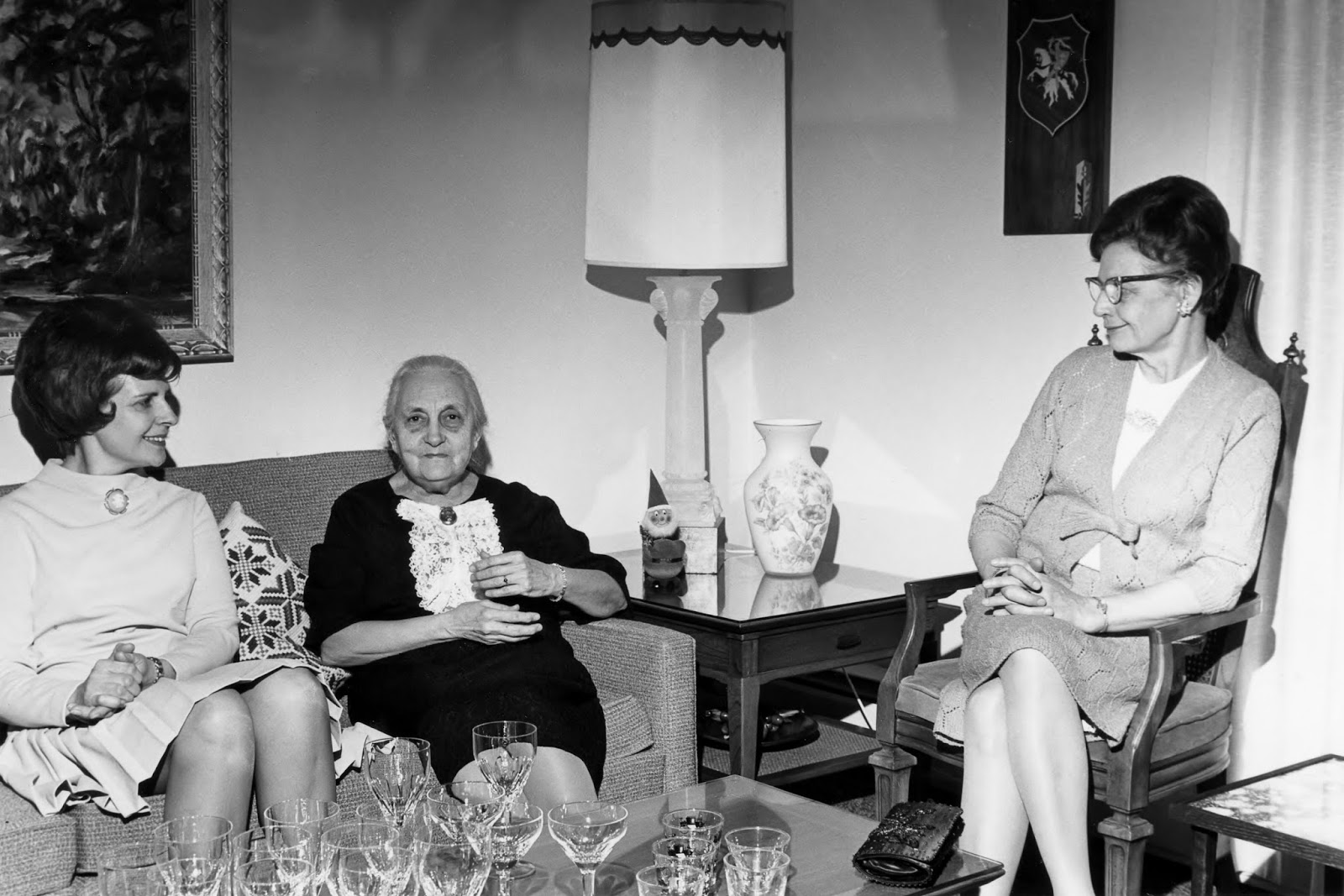
The glasses are ready.


Suburban Chicago, December 31, 1969. My Mom's best friend, Donna, and another woman chat with my paternal Grandmother, Tatjana.

December 28, 2013

Pucker up.


Suburban Chicago, December 31, 1969. My paternal Grandmother, Tatjana, dances at a New Year's Eve party hosted by Donna and Vytenis.

June 12, 2013

Family Outing


Near Vilnius, Lithuania, about 1930. Suzanne—seated on the right—and members of her family pose during a walk.

Thanks to my Kaunas Cousin for making this photo available to us.

April 12, 2013

"Tip-Top" Fashions


Suburban Chicago, November 1972. My paternal Grandmother, Tatjana, chose to send this photo to relatives in Lithuania as a memento from the party my Parents hosted in honor of her seventy-fifth birthday. On the back of the photo, Tatjana wrote, "That gentleman is 80 years old! The dresses I and [Irene's Mom] sewed were 'tip-top.' These are the fashions American women now wear for their most formal garments." 

Although Tatjana wrote the inscription in Lithuanian, she inserted the phrase "tip-top" in English.
 
This photo is from the "new batch" of snapshots that made a round trip to Lithuania and back. Thanks to my Kaunas Cousin for making it available to us.

January 25, 2013

Memories are a joy.


Russian Soviet Socialist Republic, November 6, 1969. Elena, one of the two younger sisters of my paternal Grandmother, Tatjana, writes, "To Tanjusha, my dear sister. I love you as I loved you in childhood. I am 67 years old, and I am working as a model. I am living the life of a widow. I remember everything … Mama, Papa, our brothers. Memories are a joy. I kiss you warmly."

Thanks to my friend, D, for translating the text from Russian to English.

December 13, 2011

Death and Funerals

I am not a cultural historian. I have, however, spent most of my life straddling two—and sometimes three—cultures. I've naturally made all sorts of observations. One of the ways in which Lithuanian culture differs from American culture is in its approach to death.

Although funerals are somber occasions in Lithuania, Lithuanians don't find funerals "creepy." They are occasions—passages—deserving documentation. For example, I grew up surrounded by people who took photographs at funerals. There are open-casket, wake snapshots of most of my Grandparents. When my Mom's maternal Aunt, Dora, died in 1992, Mom received a stack of color photos of Dora resting in her coffin, dressed in baby-blue satin and graced with an opulent jabot.

Lithuanians still visit graves and take snapshots of themselves standing next to family headstones.

I've mentioned this pattern of photographing the dead (and buried) to several friends. Some compare the custom to the early creation of death masks. Others speculate that people photographed the dead because of economics: photographs were expensive, and a burial photo might be the only snapshot that would commemorate a person's life. Still others assumed that a death photo was reasonable in an era when photographic technology was primitive: it was difficult for subjects to sit still through a photograph, and a corpse wouldn't even twinge during that prolonged process.

I was sifting these thoughts when I debated whether to publish the photograph of the funeral of my Mom's paternal Grandfather, Cody Sr. I decided to write this post after discussing the subject with my Toronto Cousin. She thought the photo underscores the different ways we approach death.

Consider that a reliable resource for Lithuanian Customs and Traditions lists funerals in the category of "Family Celebrations." It's customary in Lithuania, for instance, to bring children to a funeral. Whereas we "celebrate" Halloween in the States, the Festival of All Saints—November 1—is the real holiday in Europe. My Mom recalls how families gathered in the cemeteries on that day, covering the graves of loved ones with chrysanthemums. People lit candles, and by the end of the day, the cemetery would look like a rock concert awaiting an encore. When I lived in Venice, families traveled to the cemetery island of San Michele to remember the dead. In Venice, the holiday of All Saints consumed nearly a week.

The cemetery in Lithuania is a comfortable place. My paternal Grandmother, Tatjana, once fell asleep behind the locked gates of one. Upon her exit the next morning, she reported that she felt very comfortable, as though "in her own skin," while there. My Mom and my maternal Grandfather, Jake, spent a number of nights in a mausoleum when they were refugees.

There are two versions of how Cody Sr. died. My Mom's account explains that Cody left his Tauragė home and hid from the advancing Soviet forces in a country location. Because he was a prominent, middle-class government worker , Cody rightly feared that if stayed in Tauragė, he would be deported to Siberia. When the appendicitis struck, Cody's remote, primitive hideaway made it difficult for him to get medical help.

The other account maintains that Cody Sr. did not leave Tauragė. Instead, a competent doctor came to treat Cody. The doctor, a family friend, saw Cody's condition and decided he'd be better off dead than see his country unravel under Communist rule.

The twists between the two narratives make little difference to me. In both versions, Cody Sr. died because of untreated appendicitis, and in both accounts, he failed to receive life-saving surgery because the Soviets had just occupied Lithuania.

And so here is Cody Sr., surrounded by his family, his friends and colleagues, his servants, and the people of Tauragė. His wife, Wanda, clutches her hands in disbelief. She would be dead sixteen weeks later.


Tauragė, Lithuania, October 1940. Churchgoers ready to follow Cody Sr.'s casket to its burial place. My maternal Grandfather, Jake, stands to the left of the grieving Wanda.  Cody's daughter, Mary, is to the right of Wanda, and next to her is her brother, Zigmas. My Mom stands directly behind Mary, partially concealed by Mary's hat.

*     *     *     *     *

Thanks to my Toronto Cousin, and, of course, to my "New" Cousin, for providing the reflections and narratives that made this post possible.

December 7, 2011

Alpha Baba

My paternal Grandmother, Tatjana, was no wallflower. Although our "Baba" usually was cuddly and soft—inside and out—sometimes she revealed her canyons of hardship.

Tatjana occasionally articulated her resolve by wagging her finger. This could be bad or good. For example, she often delivered the gesture as a threat—"Wait till your Mother gets home" or "I'll leave if I don't get my way." At other times, she used it as an affectionate softener when she offered sage, but unsolicited, advice—"I told you so."

I couldn't distinguish between the two finger-wagging genres when I was a kid: the wagging finger always sent me flying.

This photo likely illustrates the good, "See, I'm older and smarter than you," kind of delivery:


Suburban Chicago, December 1970. Fire in those melancoly eyes: Tatjana drives home a point while talking to my Godfather.