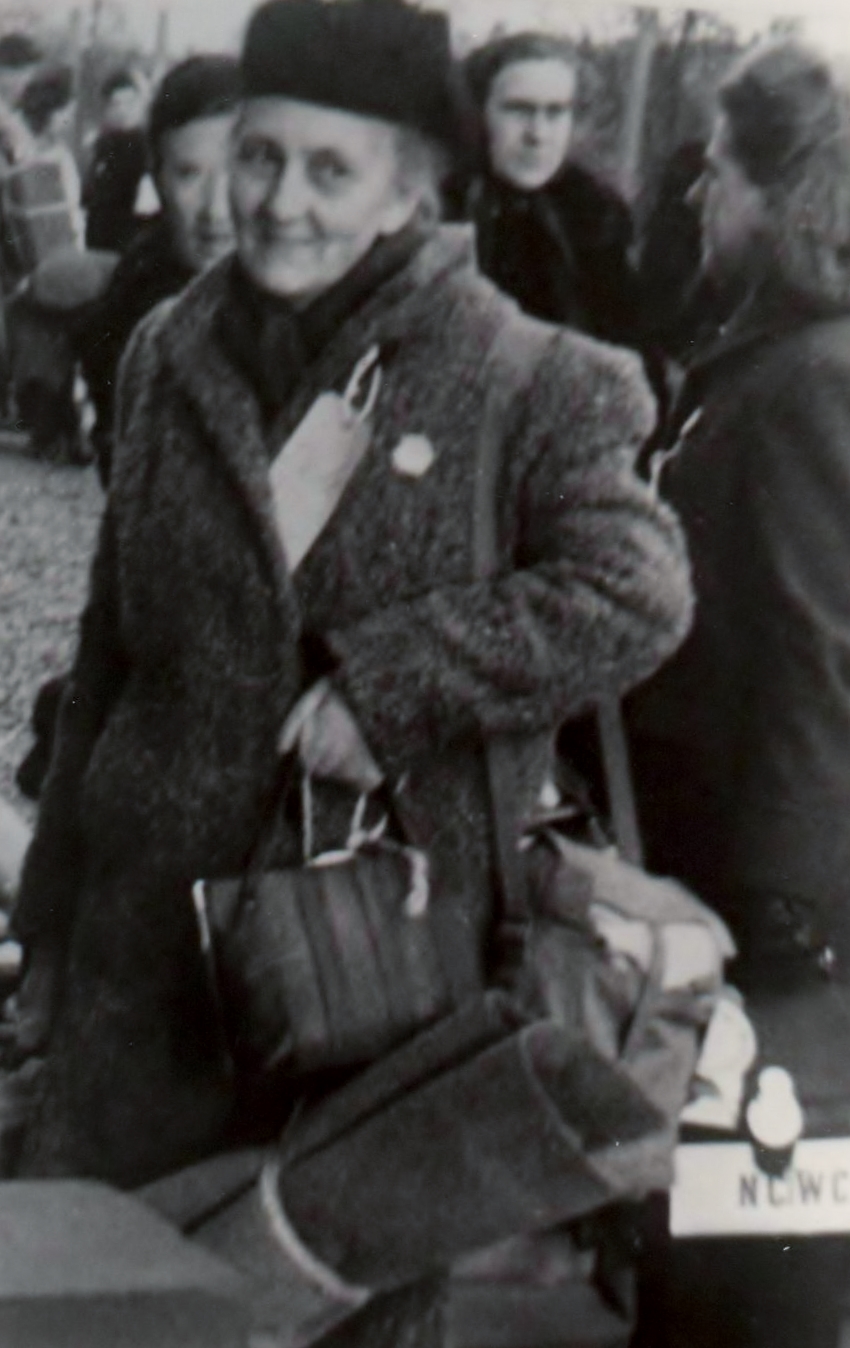
October 19, 2011

Glacier Park

Our family took a month-long vacation every summer. We usually traveled by car, and we usually drove west. The best vacations of my childhood took place in Glacier National Park, Montana. We made five trips to that destination. We always stayed in the Many Glacier area because the best hiking trails launched from that spot.

Although we wore "bear bells," I don't remember anyone being really concerned about running into a Grizzly Bear. We hiked many miles without guides or a group.


Glacier National Park, Montana, July 1970. My Parents stand atop Sperry Glacier. The three of us were on one of our day-long hikes, and I took this snapshot when we paused for lunch.

October 18, 2011

New Ties


Schweinfurt, Germany, 1948. My Dad, center, stands with a family friend—my Godfather's Mother-in-lawand his Father-in-law, my maternal Grandfather, Jake. My Dad is wearing a boutonniere because it is his wedding day.

This was Dad's favorite photo of me.


Suburban Chicago, June 1961. This photo hung for many years on the wall alongside my Dad's desk. I don't know why this shot had special meaning for him. Maybe it was the way his mother, Tatjana, had put an elastic band of silk flowers in my hair. That could have reminded him of bows in young girls' hair. Or perhaps it was because he took the photo when he and my Mom were nesting in a new home. They didn't have much money; that's why I am sitting in a lawn chair in the Rec Room. Or maybe it was the cotton jumper I wear, on which either Mom or Tatjana had embroidered red and green chickens. I think he may have liked the photo because I am not looking at the camera. I am instead daydreaming about the future.

A Close-Knit Family


Kaunas, Lithuania, around 1931. My Mom sits between her parents, Jake and Jadzė. Mom has one of those Eastern European bows in her hair; the bow is hard to see because it is blending into the wallpaper. Jake is wearing the uniform of the Lithuanian Army. His belt is a gold and olive green woven sash clasped with a brass buckle. Mr. Irene wore that belt when he and I folk danced. Mr. Irene also wears Jake's wedding band (and I wear his maternal Grandmother's ring).

Immigration

 
Bremerhaven, Germany, 1948. My paternal Grandmother, Tatjana, boards the ship that will take her to the United States. Tatjana emigrated one year before my Parents did because she was the first to find an American sponsor. She landed in New York and went to work as a cook for a Russian family whose household head worked at the United Nations. The family lived in the Hamptons.

October 17, 2011

Niagara Falls!

Niagara Falls is the perfect background for a lovely mother-daughter photo.


Niagara Falls, New York, July 1963. Mom ensured that I wore a hat in bright daylight. Even in the 1960s, she was aware of the aging and damaging effects of the sun.

Meet my Love Bug.

The first two cars I remember are my Mom's white 1960 Buick Invicta Hardtop (one of the "fin" models) and my Dad's 1957 black Volkswagon Beetle. Both cars had red interiors. My Mom drove Buicks from the late 1950s until 1991. She didn't drive stick, and she usually chose a roomy model that would be suitable for transporting five people on family vacations. For example, we drove that White Invicta, which Mom called her "Swan," from Chicago to Toronto, and then through Niagara Falls to Cape Cod in the summer of 1963. The car had no air conditioning, and I remember feeling quite green on the red vinyl of the back bench seat. During another trip, we took a mid-1960s gold LeSabre from Chicago to Montana and then up the Alaska Highway. Automatic transmission and power steering!

My Dad instead chose European cars with manua transmissions. There were two VW Beetles followed by a Volvo. When the Volvo was struck and totaled on a Chicago Expressway, Dad opted for economic prudence and bought a Buick Skylark. He hated that car, and it eventually got passed down to me. He then bought a VW Rabbit in 1979. Dad had great faith in German engineering.


Suburban Chicago, April 1961. I sit on the bumper of my Dad's black VW Beetle. An original: the engine was in the rear, the trunk was in the front, it had no headrests, no safety belts, and no car seats. Dad took me to Brookfield Zoo in this vehicle nearly every Sunday. I already am making that grown-up facial expression that I commonly struck for the lens.

Tune in.


Kaunas, Lithuania, around 1933 or 1935. My paternal Grandmother, Tatjana, tunes the radio. The radio probably was a new acquisition, or at least a novelty, at this time. Were it not, why would Tatjana have posed for a photograph with it?

Džekis

Before World War II erupted, my Mom decided to acquire a dog. She made that decision unilaterally; she did not secure her parent's permission. One afternoon, she and a childhood friend went to the home of a person who had advertised the availability of German Shepherd puppies in the newspaper. Mom paid the equivalent of half a month's salary* for a puppy. She called the pup "Džekis." In English, that name is pronounced "Jeckis."

Džekis got off to a rought start. On the way home, Mom and her friend tried to board a bus. The driver would not allow a dog on the bus. Mom and her friend instead walked many miles.* When Mom arrived home, her mother, my maternal Grandmother Jadzė, "had puppies" when she saw what her daughter had just bought.

Because Džekis was not a welcome arrival, he spent most of his youth tied on a chain in the backyard. He also did not have a job to do. These circumstances made Džekis irritable. One day, he bit a postman. Džekis relocated to a farm shortly afterward.

Mom talks about her time with Džekis as though it were moments ago. She's still in touch with the childhood friend who accompanied her on the dog adventure.

Mom's account of this episode always made me think that Jadzė disliked Džekis and had angrily banished him to the yard. Recently, however, I found a photo in which Jadzė lovingly craddles Džekis's head. I'll post it soon.
 
*That's the version, and we're sticking to it.


Kaunas, Lithuania, 1939. My Mom stands in the backyard with her beloved Džekis.

October 16, 2011

Engaging


Seligenstadt, Germany, March or April 1948. My Parents, shortly after they got engaged.

You can dance.

Like most little girls, I loved to dance. My Parents found my early interest in dance amusing. Often, when we entertained guests on Sunday afternoons—as Lithuanians do—a family member would play the piano, and I would take a spin on the living room carpet.


Suburban Chicago, 1962. I do my best to keep the guests focused on me.

  
My childhood obsession with dancing did not get beyond the living room. I was quite disappointed when my Mom barred me from enrolling in ballet lessons. She thought that ballet, and its little-girl trappings, would make me vain and would teach me the dangerous lesson that looks matter more than brains. She wanted me to be smart, not pretty. Mom had a valid point, but it's not one that I could appreciate as a child.

This restriction was especially hard because I already was a misfit at school. Our neighborhood, heavily populated by Sicilian immigrants, had few Lithuanian families. I did not speak English until I started Kindergarten. I wore glasses. My Mom cut my hair in a boyish style because she believed that keeping the hair short would make it grow back thicker. My Mom worked when all the other moms stayed at home. And then, ballet lessons were verbotten. I was bully bait.

Given the baggage, I had quite the laugh when I found this photo:


Kaunas, Lithuania, February 1930. My Mom practices ballet in her bedroom.

Every child wants a pet, but hamsters make terrible pets.

Hamsters can't be housebroken. They nest is nasty sawdust. They are nocturnal rodents. They bite. If you have more than one hamster, then the hamsters will fight. For example, we had two hamsters at one time, "Shakespeare" and "Hamlet." Shakespeare decapitated Hamlet. Although this sad event led to many family jokes about Shakespeare not liking his work, the incident had a profound effect on me, a thin-skinned toddler.

My parents eventually wised up and got a Poodle.


Suburban Chicago, November 1960. My Mom introduces me to my first pet, a hamster. We are sitting in the living room. The piano is behind me, to my left. My Mom has returned from work because she is wearing her "stay-at-home" clothes, namely, a skirt, stockings, and sweater. She often put on an apron when she came back from the office because she'd wash the dishes after my paternal Grandmother, Tatjana, cooked dinner.

Many women back then wore aprons around the house, but few women spent the day doing what my Mom did: practicing medicine.

Look forward; don't look back.

It's Sunday, and there's no better day for a stroll to a park or city square. Europeans have a tradition of getting dressed up and walking about their public places. Although it's customary to take a stroll any day in the late afternoon, the ritual really blossoms on Sunday afternoons.

Some call it a promenade. Italians refer to it as a passeggiata. When I lived in Venice in the mid-1980s, my dear landlady and I "put on our Sunday best" and walked the streets of the Lido late every Sunday afternoon. We would end the day with a nice espresso and pastry at a café.

Europeans engage in this custom during prosperous times and under under adverse circumstances. Here, for example, my Dad relaxes in a town square with friends and their children. Look at the roof of the building behind them.


Schweinfurt, Germany about 1946. Schweinfurt was one of the big DP camp towns that housed Lithuanian refugees. The camp sat in the American-occupied zone of postwar Germany. My Dad, the second adult from the left, lived in the Schweinfurt camp. The monuments likely identify this area as the entryway to the Lithuanian camp. The little tower is a replica of "Gedimino pilies bokštas," or the tower of the Gediminas Palace in Vilnius. The iconography of three crosses has special meaning in Lithuanian culture.

Schweinfurt, like Würzburg, endured horrific bombing that made the city difficult to identify for many years later. I would not have known which city this was had my Dad not written the location on his negative.

October 15, 2011

I Guest Coach the University of Wisconsin—Madison Homecoming Game.

Today I digress from the old photo posts. I instead will talk about what Mr. Irene and I did this afternoon, and I'll post some new photos.

Neither Mr. Irene nor I are true sports fans. We are, however, big fans of tradition and pageantry. When we married, for example, we asked the Roman Catholic priest who officiated at the ceremony to celebrate the wedding as a full, high Mass. After about ninety minutes into the service, our Jewish and Protestant friends looked around the church for signals that things were coming to an end.

I have studied or worked at four Big Ten schools. I also worked for two years at the University of South Carolina, the "Home of the Gamecocks." Taken together, I have lived in collegiate football towns for the last thirty-five years.

I have never been to a football game.

I used to think that I floated above the football crowd. Occasionally something would shatter that snobbery. My graduate advisor, for example, chided me for my disinterest in football. He paralleled the brilliant pageantry of football Saturdays at the University of Illinois at Urbana-Champaign to the parades of medieval Siena. When I taught at The Ohio State University, I sometimes spent Saturday afternoons in my departmental office. The thundering applause of the football crowd gave me butterflies. Here at the University of Wisconsin—Madison, I got the chills every time I saw the UW Marching Band practice.

I also spent the last nine years advising and teaching college athletes. They are among the most driven, focused, and deliberate students with whom I have worked.

Early this semester, I received an invitation to serve as one of two "Guest Coaches" for a UW—Madison Football game. Players on the team nominated *me.* I chose the Homecoming Game. Mr. Irene and I headed to Camp Randall for what turned out to be one of the most interesting days we've had.

We started the adventure by meeting and greeting the UW Police Department's K-9 Squad. There's no better way to start the morning!
 

Mr. Irene bought a program, even though we wouldn't need one.


We watched the cheerleaders practice. Wow!!
 
 
We toured the weight room.
 
 
 We watched the players warm up. 
 
 
We waited for the student fans to arrive. I wore a babushka because ... you know why. 


They arrived.  
 
 
 The University of Wisconsin Law School's third-year students tossed their canes. Google "cane toss."
 
 
We watched the game from the 25-yard line. 
 
 
ESPN watched, too.


I had a great time.  
 
 
Go Bret.  
 
 
  What do you make of this?


I posed with my student, Cassie, who plays for the UW Women's Basketball Team. 


We didn't say, "ES-FU." 
 
 
Mr. Irene and I loved the UW Marching Band. 


And we loved seeing Mr. Michael Leckrone, Director of the UW Marching Band.


We creamed the Hoosiers.

Thank you, Jerry, for helping make this a great day for me.


I never met a dog I didn't like (Autumn 2011).


Madison, Wisconsin, October 2011. I meet Odin, a member of the UW—Madison Police Department K-9 Unit, as he works the UW Homecoming Football Game.

October 14, 2011

Sometimes a winning hand is a losing proposition.

My Mom's maternal Grandmother, Zigmunta, was Polish. When she was about sixteen years old, her father challenged a young buck visiting from Lithuania to a card game. Her father, his confidence likely fueled by vodka, declared that if the Lithuanian won the game, then he would surrender his daughter's hand in marriage to the foreigner.

Later that night, Zigmunta learned that she would be the wife of Silvestras. She packed her dolls and moved to Lithuania. And so began a lifetime of bitterness and disappointment.


Mariampolis, Lithuania, 1905. Zigmunta sat for this formal portrait perhaps six or seven years into her marriage with Silvestras. My Mom recalls that Zigmunta, her maternal Grandmother, always called my Mom "Paršiva Litewka." That's a combination of (rather coarse) Lithuanian and Polish that means "nasty Lithuanian girl."

Sunny Weekend

It's going to be sunny here. Make sure you have your shades with you when you head outside.


Suburban Chicago, 1960. I head out for a Sunday visit to Brookfield Zoo.

Translations

After World War II, the United Nations Relief and Rehabilitation Administration (UNRRA) largely was responsible for the administration of the Displaced Persons camps. UNRRA appointed a French woman to oversee the Seligenstadt DP camp that became home to my Mom, Jake, and my Father-in-Law. The administrator spoke French and English, but she did not know Lithuanian, Russian, or any of the other languages spoken by the DPs.

My Mom became the camp translator. Mom translated information from Lithuanian to French for the administrator, who then converted things from French to English. Bureaucracy is historically inefficient.

Mom spoke and read six languages by the time she was a DP. English was not among those languages.


Seligenstadt, Germany, 1946. My Mom, on the far left, stands with the U.S. Army official serving in the DP camp and the French woman who served as the UNRRA administrator. Pantsuit!

Scouting

Scouting was popular in Lithuania during the years of independence, 1918 to 1940. It was more than an activity for children; it was a way for people to express their national pride. It was also, unlike other organizations, not heavily inflected with religious overtones.

My Dad participated in the Lithuanian Scouts from early childhood through his late twenties. Dad met his closest friends through scouting, and he had a poignant attachment to his memories of the organization. When Dad fell ill, he devoted hours to rephotographing and retouching the faded snapshots from his scouting years. He assembled the restored photos, which he printed himself, in an album dedicated to scouting. It was one of the last things Dad did before he died.

The scouting organizations also played important roles among Displaced Persons during the 1940s. Dad was active as a scout in the DP camps, and he served as a mentor to younger Lithuanian men. When my Parents married, the Lithuanian Scouts presented them with a traditional Lithuanian wedding gift, a decorated wooden plate. The inscription on the back of the plate read, "We wish much happiness to our dear Brother as he steps forward into a new life." That plate still rests on my desk.


Schweinfurt, Germany, 1948. My Dad, second from right, joins fellow Lithuanian Scouts in the DP camp in which they lived. This photo was taken shortly before my Parents married.

Gourd Reunion

Pick one before the frost arrives.


Spring Green, Wisconsin, September 2011.

October 13, 2011

Posing on train tracks is nothing new.

It may seem cool now, but people have been doing it for years.


Kaunas, Lithuania, 1933. My Mom, on the left (with the braids), horses around with some friends.

On a sunny October day ...

… let's put on our "stay-at-home" clothes and sit outside while we read the paper.

Fifty-one years ago today:


Suburban Chicago, October 1960. My elegant Parents relax on the patio of our backyard.

October 12, 2011

Happier Ending


Soviet Union, 1939. This is Volodia, one of the three younger brothers of my paternal Grandmother, Tatjana. Until recently, I thought he had died in the Russian Revolution at the time of his father's execution. I only learned this summer that he, like Natasha and Elena, had survived the Revolution.

Common Expression

I started knitting when I was about seven years old. By the time I was ten or so, I had knit two sweaters. I used to spend many hours knitting during summer vacations.


Lake of Bays, Ontario, 1969. "They" say that people acquire their adult faces at a young age. I don't know whether this is my adult face, but it's a common adult facial expression for me. I could not have been watching television here because our vacation cottage was not equipped with one. I must have been reacting to something someone said. Skeptical.

Diva

My Mom has a great love for opera. I have childhood memories of hearing Puccini melodies drifting up from the Rec Room on Sunday afternoons. Mom taught me to appreciate the distinct instruments different divas possessed, and by my preteen years, I could distinguish the voice of Maria Callas from that of Marilyn Horne, and Joan Sutherland from Beverly Sills. During some opera seasons, my Parents bought tickets to stagings at the Lyric Opera of Chicago. There, I saw several thrilling performances, including Sutherland in "Lucia di Lammermoor" and Leontyne Price in "Madame Butterfly." One of my first dates with Mr. Irene was to see a performance of "Don Giovanni" at the Lyric featuring Samuel Remey. Interesting choice.

When I was a graduate student, I learned that Leontyne Price would be in (the small college) town to perform a recital. I stood by the ticket window to see if any seats became available. A woman who had an ill husband sold me his spot, and we sat together in the front row of the mezzanine. When Price sang the first few notes of "Un Bel Di," my heart lept into my throat, and I wept so hard I got the hiccups. That aria swept up many memories. 


Suburban Chicago, May 1961. I belt out a tune while Mom accompanies me. The skirt I am wearing is part of some costume. Notice the plastic tub on my head, which served as a fine crown. I still remember the throw pillow on the left. It was gray, and the quilted strips were made from vivid colors. Sculpted carpeting! The still life above the piano features a lilac bouquet. It was painted for my Mom as a gift. This was before my Parents hired an "interior decorator" to redo the living room. One of the changes he made was to move that painting from above the piano and replace it with a fancy chandelier. That's sure to appear here in later photos.

On the Steps


Kaunas, Lithuania, 1938. My Mom, with her parents, Jake and Jadzė, on the front steps of the family home. The garden in the front looks lush, but Mom recalls that the backyard was even more richly landscaped. Her maternal Grandfather, Silvestras, was an expert gardener and innovator. It's likely that the tree at the forefront is one of Silvestras's fruit-grafting projects. Note that Mom is stylishly wearing anklet socks with her dress shoes.

October 11, 2011

Daddy's Girl (1961)


Suburban Chicago, 1961. Dad and I sit on the front lawn for a photograph. I barely could sit still for more than a moment in those days.