Showing posts with label opera. Show all posts
June 4, 2016
A Closer Look (Part 70)
Kaunas, Lithuania, November 11, 1939. An operetta cast member has applied her stage makeup.
Here's the original post.
January 9, 2016
Presidential Box
Kaunas, Lithuania, September 2010. My friend Nancy sits in the presidential box at the Kaunas Opera House. Nancy's Grandfather, the American Consul to Lithuania in the 1920s, had season tickets to the opera.
My Mom also attended performances in this theater.
December 16, 2015
At the Opera
Kaunas, Lithuania, March 22, 1927. The American Consul to Lithuania attends the opera. The Consul wrote:
This evening we heard Carmen at the opera with Kovno's best singer, Petrauskas. At one time, he sang with the St. Petersburg opera, but somehow drifted to Kovno after the war [see here and here]. He is an excellent singer and actor. ... The orchestra did well considering its small size. ... The scenery was good, it having been painted by a Kovno artist who went to Spain to find appropriate scenes. We were in the diplomatic box with Mr. and Mrs. Balodis (the Latvian minister), Mr. Oiderman (the Estonian representative, and Mr. Balutis, who is about to be appointed Under Secretary in the Foreign Office which will give him almost the rank of a cabinet minister. ... President and Mrs. Smetona were in the box next to us. ... The theater was completely filled and the audience was most enthusiastic, calling Petrauskas and others before the curtain many times after each act.Thanks to the Consul's Granddaughter for making this photo available to us.
August 11, 2015
Musical Memory
My Mom has been a lifelong opera and operetta lover. She and Dad occasionally bought season tickets to Chicago's Lyric Opera, and we usually listened to Saturday opera radio broadcasts (but I always preferred ballet). We celebrated New Year's Eve by watching Die Fledermaus on television, and we caught a staging of The Merry Widow in Central City, Colorado.
When Mom was growing up, the three most popular sopranos where Jeanette MacDonald, Marta Eggerth, and Deanna Durbin. Mom collected cards with images of each singer, and she and her friends went to the cinema* to watch the dubbed movies in which the starlets appeared.
In about 1934 or 1935 Marta Eggerth arrived in Kaunas for a concert. The city officials prohibited Eggerth from singing in the opera house because Eggerth specialized in operettas, a musical form, according to authorities, beneath the dignity of the opera house. Eggerth therefore sang at an outdoor theater. My Mom's maternal Aunt Dora took Mom to that concert. Mom recalls Eggerth wore a white gown on stage. When we watched a few Eggerth clips on YouTube, Mom even got a bit misty.
Vienna, Austria, July 1971. This is the Vienna State Opera. It was natural for Dad to photograph this building when we visited Vienna.
*The same cinema at which Dora used to accompany the silent movies.
When Mom was growing up, the three most popular sopranos where Jeanette MacDonald, Marta Eggerth, and Deanna Durbin. Mom collected cards with images of each singer, and she and her friends went to the cinema* to watch the dubbed movies in which the starlets appeared.
In about 1934 or 1935 Marta Eggerth arrived in Kaunas for a concert. The city officials prohibited Eggerth from singing in the opera house because Eggerth specialized in operettas, a musical form, according to authorities, beneath the dignity of the opera house. Eggerth therefore sang at an outdoor theater. My Mom's maternal Aunt Dora took Mom to that concert. Mom recalls Eggerth wore a white gown on stage. When we watched a few Eggerth clips on YouTube, Mom even got a bit misty.
Vienna, Austria, July 1971. This is the Vienna State Opera. It was natural for Dad to photograph this building when we visited Vienna.
*The same cinema at which Dora used to accompany the silent movies.
Labels:
austria,
cars,
Dad,
Deanna Durbin,
Die Fledermaus,
Dora,
Irene,
Jeanette McDonald,
Kaunas,
Lithuania,
Marta Eggerth,
Mom,
movies,
music,
opera,
singing,
theater,
vienna,
You Tube
June 3, 2015
May 14, 2013
The Life Box (Part 1)
I
though I'd lost the programs from the Rudolph
Nureyev performance I attended with my Godmother. I recall having
lent the programs to a dear, high-school friend, and I did not remember whether
she returned them. She's a do-the-right-thing kind of person—always has been—so
it was hard to imagine she didn't give it them back to me.
She
did return them; I just forgot where they were.
Mr.
Irene and I each have "life boxes." The life boxes are oversized
plastic bins into which we drop mementos. My life box contains ticket stubs,
prom dance cards, menus from restaurants, a little wooden boat Dad carved, an
empty can of vending-machine juice that I once threw at a boyfriend when I
still lived in Sherman
Hall, my First Communion rosary, the tail of a squirrel that Meškė brought home, a few political buttons, and
so on. I rifled through the life box last weekend when I wanted to pull out that
Verona
Morning Star project. At the bottom of the box was a bag in which I'd
stored programs and Playbills.
There were the
Nureyev programs. I was delighted to see that my Godmother had taken my to see
Nureyev not once, but twice.
Lyric Opera House, Chicago, Illinois, April 7, 1973. I'd forgotten about this performance.
* * * * *
Lyric Opera House, Chicago, Illinois, March 23, 1974. By the time I saw this performance, I wanted an autograph. This was the free program all audience members received.
* * * * *
Lyric Opera House, Chicago, Illinois, March 23, 1974. This was the glossy program my Godmother bought for me. I took it to the stage door after the show. I met Mr. Nureyev, but he declined to sign my program. *Whimpers.*
* * * * *
Lyric Opera House, Chicago, Illinois, March 23, 1974. Here's my ticket stub and some newspaper clippings. "Admission $7.50."
The performance was "Giselle:"
April 20, 2013
April 7, 2012
Sometimes things aren't what they're cracked up to be.
Labels:
1983,
architecture,
Graduate School,
Irene,
Italy,
Milan,
opera,
Travel
March 22, 2012
Central City
Central City, Colorado, July 1967. We've just seen a performance of The Merry Widow (my Mom's favorite operetta) at the Central City Opera House.
Labels:
1967,
cars,
Central City,
childhood,
Colorado,
eye glasses,
fashion,
Irene,
Mom,
opera,
Summer,
Vacation
November 7, 2011
Operetta
My Mom's maternal aunt, Dora, played the piano as an accompanist for silent movies. Dora also came to know many theater people.
Dora died in 1992, about one year after Lithuania regained its independence. After independence, families again could send letters and photos freely. A friend mailed many of Dora's snapshots to my Mom. Among them was this photo of the cast of a comic operetta.
Kaunas, Lithuania, November 11, 1939. Members of an operetta cast pose backstage.
Dora died in 1992, about one year after Lithuania regained its independence. After independence, families again could send letters and photos freely. A friend mailed many of Dora's snapshots to my Mom. Among them was this photo of the cast of a comic operetta.
Kaunas, Lithuania, November 11, 1939. Members of an operetta cast pose backstage.
Field Trip!!
Lithuanian high-school students wore uniforms. Almost all the time. Young people wore the uniforms because they were high-school students, not just when they were attending high school.
A Lithuanian high-school student who left her house—for whatever purpose—stepped out in her high-school uniform. My Mom, for example, remembers going, in uniform, to an evening opera performance with her Mother, Jadzė. She also recalls dressing in uniform for walks (Mom still uses the French "rendezvous" to describe an innocent stroll with a friend) and shopping on the weekends.
Each high school had a differently colored uniform, and students wore caps with visor badges that identified their schools. The uniforms in girls' schools consisted of dark dresses, dark tights, bow ties, and removable white collars that could be laundered more frequently.
The rule, I think, had a two-fold purpose. First, if a student got into trouble, it would be easy to identify the student based on her school. Second, it's likely that the high schools had different social rankings, and a uniform instantly would peg a student "in her place."
Mariampolis, Lithuania, 1940. My Mom and her high-school classmates travel from Kaunas to visit a beet-sugar factory. Mom stands in the very center of the first row—at the "base" of the visual pyramid. She's wearing her school cap.
The Soviets had just launched their occupation of Lithuania. Here, two Soviet soldiers stand among the girls. I assume that the three men on the left are high-school teachers.
A Lithuanian high-school student who left her house—for whatever purpose—stepped out in her high-school uniform. My Mom, for example, remembers going, in uniform, to an evening opera performance with her Mother, Jadzė. She also recalls dressing in uniform for walks (Mom still uses the French "rendezvous" to describe an innocent stroll with a friend) and shopping on the weekends.
Each high school had a differently colored uniform, and students wore caps with visor badges that identified their schools. The uniforms in girls' schools consisted of dark dresses, dark tights, bow ties, and removable white collars that could be laundered more frequently.
The rule, I think, had a two-fold purpose. First, if a student got into trouble, it would be easy to identify the student based on her school. Second, it's likely that the high schools had different social rankings, and a uniform instantly would peg a student "in her place."
Mariampolis, Lithuania, 1940. My Mom and her high-school classmates travel from Kaunas to visit a beet-sugar factory. Mom stands in the very center of the first row—at the "base" of the visual pyramid. She's wearing her school cap.
The Soviets had just launched their occupation of Lithuania. Here, two Soviet soldiers stand among the girls. I assume that the three men on the left are high-school teachers.
October 31, 2011
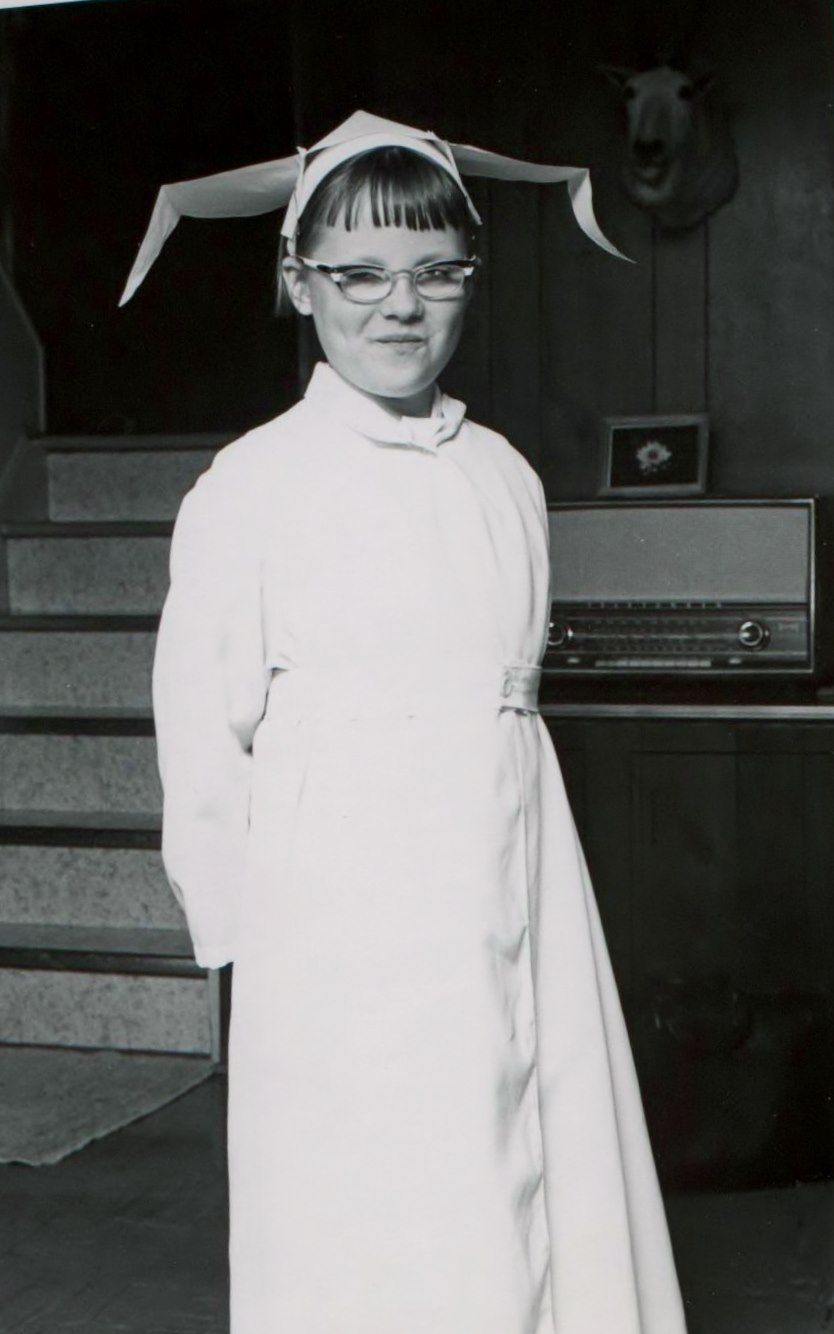
I am going as my favorite sitcom character.
I model my "Flying Nun" Halloween costume. My paternal Grandmother, Tatjana, sewed the garment, and I made the headpiece.
Tatjana stitched a matching, white bag in which I collected the candy. It rained that afternoon, and as I trick-or-treated, I dragged the cloth bag along the wet sidewalks and through the puddles. When I returned home, my Mom confiscated the wet candy and threw all of it away. She offered me whatever was left over at our house, but that was no consolation. I wanted the thrilling variety of my gathered stash, which surely contained treasures that my Mom would never buy.
Suburban Chicago, October 31, 1967. That's a taxidermied mountain goat head hanging on the cherry-paneled wall of our Rec Room. We bought the object in Glacier National Park. On the ledge sits the great old radio on which my Mom used to listen to Opera at the Met.
Tatjana stitched a matching, white bag in which I collected the candy. It rained that afternoon, and as I trick-or-treated, I dragged the cloth bag along the wet sidewalks and through the puddles. When I returned home, my Mom confiscated the wet candy and threw all of it away. She offered me whatever was left over at our house, but that was no consolation. I wanted the thrilling variety of my gathered stash, which surely contained treasures that my Mom would never buy.
Suburban Chicago, October 31, 1967. That's a taxidermied mountain goat head hanging on the cherry-paneled wall of our Rec Room. We bought the object in Glacier National Park. On the ledge sits the great old radio on which my Mom used to listen to Opera at the Met.
October 12, 2011
Diva
My Mom has a great love for opera. I have childhood memories of hearing Puccini melodies drifting up from the Rec Room on Sunday afternoons. Mom taught me to appreciate the distinct instruments different divas possessed, and by my preteen years, I could distinguish the voice of Maria Callas from that of Marilyn Horne, and Joan Sutherland from Beverly Sills. During some opera seasons, my Parents bought tickets to stagings at the Lyric Opera of Chicago. There, I saw several thrilling performances, including Sutherland in "Lucia di Lammermoor" and Leontyne Price in "Madame Butterfly." One of my first dates with Mr. Irene was to see a performance of "Don Giovanni" at the Lyric featuring Samuel Remey. Interesting choice.
When I was a graduate student, I learned that Leontyne Price would be in (the small college) town to perform a recital. I stood by the ticket window to see if any seats became available. A woman who had an ill husband sold me his spot, and we sat together in the front row of the mezzanine. When Price sang the first few notes of "Un Bel Di," my heart lept into my throat, and I wept so hard I got the hiccups. That aria swept up many memories.
Suburban Chicago, May 1961. I belt out a tune while Mom accompanies me. The skirt I am wearing is part of some costume. Notice the plastic tub on my head, which served as a fine crown. I still remember the throw pillow on the left. It was gray, and the quilted strips were made from vivid colors. Sculpted carpeting! The still life above the piano features a lilac bouquet. It was painted for my Mom as a gift. This was before my Parents hired an "interior decorator" to redo the living room. One of the changes he made was to move that painting from above the piano and replace it with a fancy chandelier. That's sure to appear here in later photos.
When I was a graduate student, I learned that Leontyne Price would be in (the small college) town to perform a recital. I stood by the ticket window to see if any seats became available. A woman who had an ill husband sold me his spot, and we sat together in the front row of the mezzanine. When Price sang the first few notes of "Un Bel Di," my heart lept into my throat, and I wept so hard I got the hiccups. That aria swept up many memories.
Labels:
1961,
art,
chandelier,
childhood,
Graduate School,
Happy,
Irene,
Lilacs,
Mom,
Mr. Irene,
opera,
Parents,
piano,
Rec Room,
Suburban Chicago,
Urbana
Subscribe to:
Posts (Atom)