Showing posts with label stockyards. Show all posts
Showing posts with label stockyards. Show all posts
January 28, 2014
A Conversation about "First Wavers"
Chicago's
WBEZ interviews
Lithuanian Americans about Upton Sinclair's The Jungle.


June 3, 2013
Related by Marriage: Anniversary Toast

St. George's Parish, Bridgeport, Chicago, June 1917. Today is the ninety-sixth wedding anniversary of Mr. Irene' maternal Grandparents, Anna and Stanley.
We've got a bottle of
Chandon chilling in the refrigerator; we'll toast the wedding
party tonight.
January 26, 2013
Related by Marriage: The Brown Deer
In the early 1960s, Mr. Irene's maternal Aunt Martha and her husband, Wally, owned and operated a bar, "The Brown Deer." It stood on Chicago's South Side, at South Halsted Street near 78th Street. Wally worked on construction projects during the weekdays, and he dropped Martha off at The Brown Deer in time for its opening at 7:00 am. Frequently some regulars, who were just finishing their night shifts, would be waiting for Martha to start serving their preferred "happy-hour" drink: a shot of whiskey and a glass of beer. Other patrons stopped in a for a quick one on the way to their factory jobs or during lunch breaks. Wally joined Martha to tend bar at The Brown Deer after his construction work was done for the day.
Following a longstanding saloon tradition, bar snacks and lunches were served free-of-charge to customers who bought a drink. Hard-boiled eggs and dill pickles were always on hand. Corned beef sandwiches were popular at noon. Martha even ran a Friday fish-fry dinner at the tavern for a couple of years.

Chicago, Illinois, 1964. Wally tends the bar. "Absolutely No Checks Cashed."
December 15, 2012
Related by Marriage: Another Swing

Vytautas Grove, Chicago, Illinois, 1935. Mr. Irene's maternal Grandfather, Stanley, takes Mr. Irene's Mom to the swingset.
December 10, 2012
The Arrival of the First Wavers
Or, "How Chicago became Lithuania's second capital."
Chicago's Public Television station, WTTW, also addressed the subject in "Lithuanians in Chicago," an episode in its "Chicago Stories" series.
Read more here about the first wavers on Mr. Irene's maternal side of the family.
Chicago's Public Television station, WTTW, also addressed the subject in "Lithuanians in Chicago," an episode in its "Chicago Stories" series.
Read more here about the first wavers on Mr. Irene's maternal side of the family.
October 29, 2012
Related by Marriage: First Apartment, Same Neighborhood
Throughout the 1950s and 1960s, many Lithuanian Displaced Persons lived, worked, and socialized within the radius of a few miles. This was true for new arrivals who settled in the neighborhoods of Brighton Park, Gage Park, Marquette Park, West Lawn, and Archer Heights. Those neighborhoods surrounded Midway Airport.
When Mr. Irene's Dad first arrived in Chicago in 1949, he lived in a boardinghouse just across the street from the family home of his sponsor. A first-wave Lithuanian woman owned the boarding house; she rented rooms and provided meals to second-wave, single men. A cousin of Mr. Irene's Dad, who fled Lithuania with Dad and his brother Ignas, lived just a few doors down with her husband and young daughter in rented rooms on the same block in Brighton Park, South Artesian, near 40th Street.
After completing his U.S. Army service in 1953, Mr. Irene's Dad returned to the same boardinghouse and eventually found work alongside fellow Lithuanian DPs in a factory that manufactured seats for Ford automobiles. The factory stood in a sprawling industrial district along 65th Street, between Cicero and Narraganset Avenues. Just a few blocks south along Cicero Avenue were other manufacturing neighbors like a Ford assembly plant (that became the Ford City Shopping Center in 1965), Tootsie Roll, Sweetheart Cup, and Cracker Jack.
Mr. Irene's Dad shared his room with an older fellow he had known in the Displaced Persons camp at Seligenstadt. In early 1956, while Mr. Irene's Dad was visiting his brother in Los Angeles, his roommate passed away in his sleep, presumably from a heart attack.

Brighton Park, Spring, 1956. Immaculate Conception Lithuanian Catholic Church. Mr. Irene's Dad, standing at the front, on the right, serves as a pallbearer for the funeral of his boarding house roommate. Many younger DPs, however, were not Immaculate Conception parishoners. Instead, they attended Sunday Mass at Holy Cross Parish near 46th and Woods, in the nearby Back of the Yards neighborhood.

Brighton Park, Chicago, Illinois, sometime between 1956 and 1957. Mr. Irene's Dad relaxes on the sofa in his new apartment. The flat stood behind a first-floor grocery store operated by the owners of the six-unit building, themselves recently arrived DPs. The apartment had two bedrooms and an ample, eat-in kitchen. Mr. Irene's Dad made good use of his Army mess-hall training: quick sales at the grocery store frequently prompted hearty pork chop dinners.
When Mr. Irene's Dad first arrived in Chicago in 1949, he lived in a boardinghouse just across the street from the family home of his sponsor. A first-wave Lithuanian woman owned the boarding house; she rented rooms and provided meals to second-wave, single men. A cousin of Mr. Irene's Dad, who fled Lithuania with Dad and his brother Ignas, lived just a few doors down with her husband and young daughter in rented rooms on the same block in Brighton Park, South Artesian, near 40th Street.
After completing his U.S. Army service in 1953, Mr. Irene's Dad returned to the same boardinghouse and eventually found work alongside fellow Lithuanian DPs in a factory that manufactured seats for Ford automobiles. The factory stood in a sprawling industrial district along 65th Street, between Cicero and Narraganset Avenues. Just a few blocks south along Cicero Avenue were other manufacturing neighbors like a Ford assembly plant (that became the Ford City Shopping Center in 1965), Tootsie Roll, Sweetheart Cup, and Cracker Jack.
Mr. Irene's Dad shared his room with an older fellow he had known in the Displaced Persons camp at Seligenstadt. In early 1956, while Mr. Irene's Dad was visiting his brother in Los Angeles, his roommate passed away in his sleep, presumably from a heart attack.

Brighton Park, Spring, 1956. Immaculate Conception Lithuanian Catholic Church. Mr. Irene's Dad, standing at the front, on the right, serves as a pallbearer for the funeral of his boarding house roommate. Many younger DPs, however, were not Immaculate Conception parishoners. Instead, they attended Sunday Mass at Holy Cross Parish near 46th and Woods, in the nearby Back of the Yards neighborhood.
* * * * *
Shortly after the funeral, Mr. Irene's Dad moved into his first apartment with another immigrant friend. The spacious flat was just a few blocks south of his old boardinghouse, near the intersection of 43rd and Campbell. Mr. Irene's Dad occupied that apartment until his wedding day.

* * * * *


Vytautas Grove, Chicago, Illinois, about 1957. Mr Irene's Dad and his apartment roommate chat in the parking lot during a Sunday picnic.
June 1, 2012
Related by Marriage: Fundraising Picnic

Vytautas Grove, Chicago, Illinois, 1949. Here's another view of a picnic organized to raise funds to support the arrival of Displaced Persons in the United States. Mr. Irene's maternal Grandparents, Stanley and Anna, sit on the left, and Anna's sister, Petra, is in the center, on the right.
March 18, 2012
Related by Marriage: Supporting the newcomers.
In the aftermath of World War II, the "first wave" of Lithuanians already living in the United States played important roles in the resettlement of the emigrating Displaced Persons. The first wavers did so despite some of the chaffing socio-economic tensions that existed between them and the DPs.
Many first wavers served as sponsors to the DPs. Others supported the new arrivals financially. In many cases, first wavers privately financed home mortgages for the DPs. In other instances, first wavers quietly made the twenty-percent down payments then necessary to purchase a house.
A good way to collect money for the DPs was to sponsor a picnic. The benefit picnics often took place at Vytautas Grove, on Chicago's South Side, behind the stockyards. Organizers would collect money for the DPs at the picnics, and the picnics usually featured a raffle, or fundraising "loterija."

Vytautas Grove, Chicago, Illinois, 1949. Mr. Irene's maternal Grandmother, Anna, sits on the far left at a fundraising picnic. Her spinster sister, Petra, stands behind the group.

Vytautas Grove, Chicago, Illinois, 1949. Here, Petra sits on the left side of the picnic table with Mr. Irene's maternal Grandfather, Stanley. Grandmother Anna is on the other side of the table, at the far left end.
Many first wavers served as sponsors to the DPs. Others supported the new arrivals financially. In many cases, first wavers privately financed home mortgages for the DPs. In other instances, first wavers quietly made the twenty-percent down payments then necessary to purchase a house.
A good way to collect money for the DPs was to sponsor a picnic. The benefit picnics often took place at Vytautas Grove, on Chicago's South Side, behind the stockyards. Organizers would collect money for the DPs at the picnics, and the picnics usually featured a raffle, or fundraising "loterija."

Vytautas Grove, Chicago, Illinois, 1949. Mr. Irene's maternal Grandmother, Anna, sits on the far left at a fundraising picnic. Her spinster sister, Petra, stands behind the group.
* * * * *

Vytautas Grove, Chicago, Illinois, 1949. Here, Petra sits on the left side of the picnic table with Mr. Irene's maternal Grandfather, Stanley. Grandmother Anna is on the other side of the table, at the far left end.
December 30, 2011
Related by Marriage: Uncle Benny
Mr. Irene's Mom was the youngest of five children born to Anna and Stanley. Aunt M was the eldest; the three middle children died. The death of the three children speaks to life in the early twentieth century, when there were no antibiotics, and the danger of death could be a sniffle away. It's no wonder that Mr. Irene's Mom still says, "Oh no!" each time someone sneezes.
The second child and the only son, Benny, was three years younger than Aunt M. Benny had a wonderful pet dog, "Sporty." Sporty bonded only to Benny. Benny was an active boy. One afternoon, he ran out to the playground, and a stray, stockyards dog bit him. Benny returned home to show his mother, Anna, the wound. The wound became infected. Anna took Benny to the hospital. Doctors admitted Benny. In the hospital, Benny developed sepsis.
Benny lingered in the hospital, but there were no drugs with which to treat him. One afternoon, Sporty howled. Anna looked at the family and said, "Benny has died." After the family buried Benny, Sporty refused to leave Benny's room. He wouldn't eat. Shortly thereafter, Sporty died, too.
When I think about that story, I remember the movie, "My Dog Skip."

Bridgeport, Chicago, 1927. Aunt M (Martha) poses with her younger brother, Benny. He died three years later.
The second child and the only son, Benny, was three years younger than Aunt M. Benny had a wonderful pet dog, "Sporty." Sporty bonded only to Benny. Benny was an active boy. One afternoon, he ran out to the playground, and a stray, stockyards dog bit him. Benny returned home to show his mother, Anna, the wound. The wound became infected. Anna took Benny to the hospital. Doctors admitted Benny. In the hospital, Benny developed sepsis.
Benny lingered in the hospital, but there were no drugs with which to treat him. One afternoon, Sporty howled. Anna looked at the family and said, "Benny has died." After the family buried Benny, Sporty refused to leave Benny's room. He wouldn't eat. Shortly thereafter, Sporty died, too.
When I think about that story, I remember the movie, "My Dog Skip."

December 23, 2011
Related by Marriage: Meet the Butcher
Mr. Irene and I visited an upscale grocery store today to pick up some additional items for our Kūčios table. We stopped at the meat counter to look at some of the unusual sausages for sale. While there, we asked the butcher whether he carried any potato sausages. A coworker asked the butcher what potato sausages were, and the butcher paused, explaining that they were a "Swedish" food. When Mr. Irene and I burst out that Lithuanians eat potato sausages too, the butcher laughed and told us that he, too, is Lithuanian.
It was nice to meet you today, butcher Paul. This post is for you.
Mr. Irene's maternal Grandfather, Stanley, was a Lithuanian butcher. For a time, he ran a butcher shop and small grocery store in Brighton Park, near the intersection of 44th and Fairchild. He owned the place for about ten years, but it went under during the Great Depression. In the mid-1930s, Stanley began working for Benjamin Moore, which then had a plant on Chicago's South Side. When Benjamin Moore relocated its operation to suburban Melrose Park, Stanley continued to work for the company, commuting daily from his home in Marquette Park.
After Mr. Irene's Parents married, Stanley helped Mr. Irene's Dad get a job at Benjamin Moore. My Father-in-Law mixed paint at Benjamin Moore for over thirty-five years.
When Stanley retired from Benjamin Moore, he again worked as a butcher, this time on a part-time basis in a Marquette Park shop.

Brighton Park, Chicago, 1925. Mr. Irene's maternal Grandfather, Stanley, stands behind the counter of the butcher shop. The man on the counter's other side is a distributor, and the men posed for this photo to commemorate the distributor's visit.
It was nice to meet you today, butcher Paul. This post is for you.
Mr. Irene's maternal Grandfather, Stanley, was a Lithuanian butcher. For a time, he ran a butcher shop and small grocery store in Brighton Park, near the intersection of 44th and Fairchild. He owned the place for about ten years, but it went under during the Great Depression. In the mid-1930s, Stanley began working for Benjamin Moore, which then had a plant on Chicago's South Side. When Benjamin Moore relocated its operation to suburban Melrose Park, Stanley continued to work for the company, commuting daily from his home in Marquette Park.
After Mr. Irene's Parents married, Stanley helped Mr. Irene's Dad get a job at Benjamin Moore. My Father-in-Law mixed paint at Benjamin Moore for over thirty-five years.
When Stanley retired from Benjamin Moore, he again worked as a butcher, this time on a part-time basis in a Marquette Park shop.
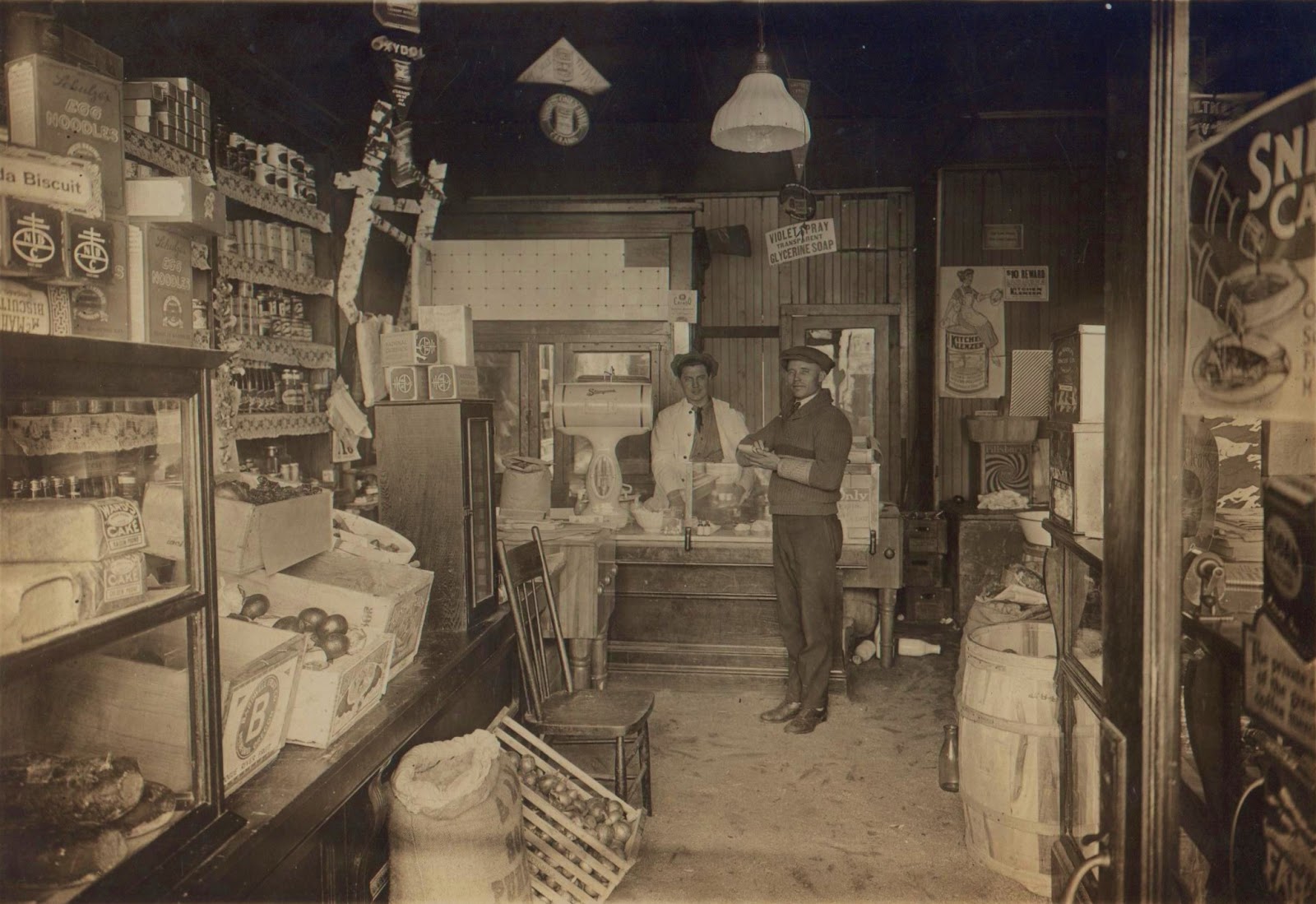
Brighton Park, Chicago, 1925. Mr. Irene's maternal Grandfather, Stanley, stands behind the counter of the butcher shop. The man on the counter's other side is a distributor, and the men posed for this photo to commemorate the distributor's visit.
December 15, 2011
Related by Marriage: Church Ladies

St. George's Parish, Bridgeport, Chicago, 1922. A group of first-wavers stands outside the Lithuanian church. Mr. Irene's maternal Grandmother, Anna, is tucked as fifth person from the left—she's the one with the white feathers in her hat! Anna's spinster sister, Petra, is the second person on the right—she has her left hand tucked into her coat.
Although this is a working-class group of women—most of their husbands labored in the stockyards—a couple of the ladies appear to be wearing fur coats (likely karakul).
November 29, 2011
Related by Marriage: The Wedding Rings
I mentioned—I think twice before—that Mr. Irene and I exchanged our Grandparents' bands as our wedding rings. I've already introduced my maternal Grandfather, Jake. He's the person whose ring Mr. Irene wears.
These are Mr. Irene's maternal Grandparents, Anna and Stanley, on their wedding day. Anna and Stanley each emigrated from Lithuania as teenagers. They met and married in Chicago. Their wedding took place at the first Lithuanian parish in the city, St. George's.
Lithuanians divide their immigration histories into three waves ("bangos"). Mr. Irene's maternal Grandparents emigrated to the United States during the "first wave," that is, during the early part of the twentieth century. The "second wave" rolled in when the Displaced Persons—my Parents and Mr. Irene's Dad—sailed over. The "third wave" arrived after 1991, when Lithuania secured its independence from the Soviet Union, and people again could come and go out of the country unfettered by restrictions.
Mr. Irene's maternal Grandparents are the type of folk about whom Upton Sinclair wrote in The Jungle. These were the Lithuanian immigrants who worked in the Chicago stockyards, who owned the butcher shops, who populated the South Side, and whose identity pivoted around the Roman Catholic parishes to which they belonged.
Mr. Irene and I had no idea that we had scheduled our wedding on the same calendar date as the anniversary of his maternal Grandparents. My wedding band therefore has one date—and two different years—inscribed in it.

St. George's Parish, Bridgeport, Chicago, June 1917. Mr. Irene's maternal Grandparents, Anna and Stanley, pose for an elaborate wedding portrait.
Check out the bridal bouquet!
Subscribe to:
Posts (Atom)